© Ahmadiyya Anjuman Lahore Foundation (UK)
In the Name of Allah, the Beneficent, the Merciful
The Islamic View
Patron: Mr Nasir Ahmad · Editor: Dr Zahid Aziz

Worldwide Lahore Ahmadiyya Movement
A Magazine of the Central Ahmadiyya Anjuman, Lahore
Available online at: www.jamaat.uk/islamic-view/
August 2026 · Vol. 2, No. 8
Contents
A person’s own decision in matters of marriage, according to Islam
Friday khutba for Lahore Ahmadiyya UK, 12 June 2026, by Dr Zahid Aziz
Jewish views on the birth of Jesus from Western researches
Compiled by Zahid Aziz
Hazrat Maulana Nur-ud-Din’s answers to five basic questions
Maulana Sanaullah of Amritsar declared all Ahmadis as Muslims in 1915
The Concealed Garden: Reflections on Jannah in the Quran
Talk at the UK Lahore Ahmadiyya Centre, London, 5 July 2026, by Zainab Nazir
Lahore Ahmadiyya Islamic Society Convention
Friday khutba for Lahore Ahmadiyya UK, 12 June 2026,
by Dr Zahid Aziz
یٰۤاَیُّہَاالنَّبِیُّ قُلۡ لِّاَزۡوَاجِکَ اِنۡ کُنۡـتُنَّ تُرِدۡنَ الۡحَیٰوۃَ الدُّنۡیَا وَ زِیۡنَتَہَا فَتَعَالَیۡنَ اُمَتِّعۡکُنَّ وَ اُسَرِّحۡکُنَّ سَرَاحًا جَمِیۡلًا ﴿۲۸﴾ وَ اِنۡ کُنۡـتُنَّ تُرِدۡنَ اللّٰہَ وَ رَسُوۡلَہٗ وَ الدَّارَ الۡاٰخِرَۃَ فَاِنَّ اللّٰہَ اَعَدَّ لِلۡمُحۡسِنٰتِ مِنۡکُنَّ اَجۡرًا عَظِیۡمًا ﴿۲۹﴾
These verses were revealed at a very late period when Muslims in Madinah had achieved several victories over their enemies and had started becoming prosperous. Some say that these were revealed even later, when the Holy Prophet Muhammad ruled over the whole of Arabia. Yet despite this change of circumstances for the better, he and his household continued to live sparsely with just the bare essentials required for living. Hazrat Umar related, in connection with the events of the revelation of these verses:
“I went to see the Prophet and saw him lying on a mat without bedding on it, and the mat had left its mark on the body of the Prophet, and he was leaning on a leather pillow stuffed with palm fibres. … I sat down and cast a glance at the room, and by Allah, I could not see anything worthwhile but three hides. I said to him: Call on Allah to make your followers prosperous, for the Persians and the Byzantines have been made prosperous and given worldly luxuries, though they do not worship Allah.”
The Holy Prophet replied:
“Are you in doubt (i.e., that the Hereafter is better than this world)? These people have been given their good things in the life of this world” (Bukhari, hadith 2468).
A Companion relates:
“There were never three days in a row when the family of Muhammad got to eat fully on all those days, till he died” (Bukhari, hadith 5374).
Hazrat Aishah herself related:
“Till the death of the Prophet, we satisfied our hunger with the two black things, that is, dates and water” (hadith 5383).
The wives of the Holy Prophet began to feel that, with the whole Muslim community becoming prosperous, his household should share in that prosperity as well. This was a natural desire. However, only a few verses earlier, in verse 21 of this chapter, Allah had declared to the Muslims that the Messenger of Allah was the best exemplar for them. This implies that his household also should be an example. In the verses I recited, Allah directed the Holy Prophet to say to his wives that if they desire the good and material things of this life, he would let them have some of them, but let them depart from his household in an amicable and harmonious way, with good grace. On the other hand, they could instead choose to keep a better connection with Allah and His Messenger and good in the Hereafter, for a greater reward. Thus the Holy Prophet offered each of his wives the choice to leave him or to remain with him. If they chose to leave him, the Holy Prophet would take it in a friendly way, with no hint of any bitterness or rancour. This verse is known as a verse of takhayyar, meaning that the Holy Prophet gave his wives the discretion and choice to decide as they wished.
We can see that the Holy Prophet did not wish to force his wives to live with him in a lifestyle of deprivation if they could not accept or tolerate such a way of living. Having such great consideration for his wives teaches a lesson to all Muslim husbands to show consideration for the feelings and burdens of their wives. This incident also shows that the Holy Prophet had not married any of his wives without willingness on their part, because he is allowing them to leave him, and to leave with some wealth which he would bestow upon them. It is commonly said in Muslim societies, especially of the Indian subcontinent, that it is Allah Who determines and ordains whom a person marries. They say it is not actually humans who make that decision. If this was correct, Allah could never have asked the Holy Prophet to allow his wives the choice to leave him.
Hazrat Aishah relates that when these verses were revealed, the Holy Prophet first came to her to put this choice to her, and he said:
“I am going to tell you something, but you need not hurry to give the reply till you consult your parents.”
She continues: “He knew that my parents would not advise me to separate.”
Then the Holy Prophet informed her of these two verses (33:28–29). She replied:
“Why should I ask my parents for advice in this matter? I desire Allah and His Messenger and the abode of the Hereafter.”
She must have wanted to give this reply based on her own decision without influence from anyone else. If she had consulted her parents, and as expected they (Hazrat Abu Bakr and his wife) had told her to remain with the Holy Prophet, it could be said that this was not her entirely independent decision. Notice also that the Holy Prophet was not pressuring her for an immediate decision, but to reflect on it and consult those who had her best interests at heart (see Bukhari, hadith 4785 and 2468.)
It is added in hadith 2468 that the Holy Prophet then offered the same choice to his other wives and they gave him the same reply as Aishah. We can see the reason why he asked each wife individually, in privacy. If he had asked them all together as a group, even if any of them had wanted to take worldly wealth and leave him, she would not have been able to say this in the presence of all others. In some versions, Hazrat Aishah asked the Holy Prophet not to mention her decision to any of the other wives (Sahih Muslim, hadith 1478). She may have been concerned that this would influence them to give the same reply as her.
In this case, of course, no divorce took place. But I may mention another well-known incident related in the Quran, that of Zaid ibn Haritha and Zainab. Interestingly, this incident is mentioned in the same chapter of the Quran, less than ten verses later. Zaid was a slave purchased by Hazrat Khadijah. When she married the Holy Prophet, she gave him Zaid as a gift. The Holy Prophet liberated Zaid and he became very attached to Zaid. Some years later Zaid’s family discovered that he was living in Makkah. His father and his uncle came to fetch him and told the Holy Prophet that they would pay him anything to get him back. The Holy Prophet told them that Zaid should decide whether to go with his family or not, and that if he chose to go with them, the Holy Prophet would not take any payment from them. Zaid was called and he told his father and his uncle that he could not leave the Holy Prophet because of love for him. At this, the Holy Prophet declared Zaid as his adopted son.
This was in the pre-prophethood days of the Holy Prophet. Later on, when the Holy Prophet was appointed by Allah as His Messenger, Zaid was one of the first persons to accept Islam. From being a slave, Zaid became known as “son of Muhammad”, and some years later he was married to the Holy Prophet’s cousin Zainab by the Holy Prophet.
The Holy Prophet had been insistent on this marriage in order to set the example that in Islam someone from a slave origin could be married to someone from a leading family like the Quraish, because all are equal in Islam regardless of the society considering one of them as socially low and the other as socially high. Unfortunately, this marriage did not turn out to be happy as neither could adjust to the other because of their very different social standings and behaviour. Zaid complained to the Holy Prophet about Zainab’s attitude, but the Holy Prophet gave him this advice, which is stated in the Quran as follows:
“And when you said to him (Zaid) to whom Allah had shown favour and to whom you had shown a favour: Keep your wife to yourself and keep your duty to Allah” (33:37).
But as the Quran later says in the same verse:
“So when Zaid dissolved her marriage-tie, We gave her to you as a wife… .”
Zaid divorced Zainab against the Holy Prophet’s advice. Allah and the Holy Prophet had shown Zaid many favours in his life. He had been granted freedom from slavery and closeness to the Holy Prophet. But he is allowed to exercise his choice to end the marriage with Zainab, despite the marriage being at the wish of the Holy Prophet and the Holy Prophet advising its continuity. There is no condemnation of Zaid by Allah or the Holy Prophet for ending his marriage. This shows the highest place given by Islam to an individual’s rights and decisions in personal matters of like and dislike.
As the Quran also adds, the Holy Prophet then married Zainab. Maulana Muhammad Ali writes under his verse:
“After Zainab was divorced, the Holy Prophet took her in marriage, that being the wish of the lady and her relatives before her marriage to Zaid, and the Prophet was, now that the marriage arranged by him proved unsuccessful, morally bound to accept their wishes.”
I may also point out that by marrying Zainab, the Holy Prophet was marrying a divorced woman, who had previously being married to a freed slave, a man of low social standing. Thus he showed by his example that a woman should not be put to disadvantage because of such considerations.
There is another incident of note in this connection. It is reported in Bukhari that Hazrat Aishah purchased the freedom of a slave woman called Bareera (hadith 6751). During slavery, she was married to a slave called Mughees, who was still a slave. In such cases Islam gives the freed slave woman the choice to remain with her still enslaved husband or to divorce him. She divorced him, but he loved her. It is related by Ibn Abbas that he used to see Mughees following Bareera in the streets, weeping so much that tears would be flowing down his beard, to persuade her to remain with him. The Holy Prophet said:
“Are you not astonished at the love of Mughees for Bareera and the hatred of Bareera for Mughees?”
The Holy Prophet then said to Bareera:
“Why don’t you return to him?”
She said: “O Messenger of Allah, do you order me to do so?”
He replied: “No, I am only appealing to you for him.”
She said: “I am not in need of him” (Bukhari, Book of Divorce, hadith 5283).
In Bukhari again there is a report from Hazrat Aishah about Bareera, saying that three principles of Sunnah were established from her case, the first being that she was given choice in the matter of her husband when she was freed from slavery (hadith 5097). In another hadith in Bukhari it is stated:
“Bareera was given the choice and she chose to separate from him. She said: If I were given so much wealth, I would still not stay with him” (Bukhari, hadith 6754).
What Zaid or Bareera did was not considered by anyone as being wrong. Instead, their personal inclinations in marital relationships were respected in Islam and by the Holy Prophet as the determining factor in their lives.
Unfortunately, Muslim societies have neglected to accord these rights to their women and their men, which is a cause of domestic and family problems, as well as bringing Islam into disrepute. May Allah deliver us all from this neglect. Ameen.
Note: The audio form of this khutba is available at the following link:
www.youtube.com/watch?v=LjL7euX6--0
In the English translation of the Holy Quran by Maulana Muhammad Ali, there is a brief footnote under the verse: “And for their disbelief and for their uttering against Mary a grievous calumny” (4:156) — this verse being in reference to the Jews who rejected Jesus as a prophet and the Messiah. The footnote is as follows:
“The calumny referred to was that Mary was guilty of fornication (Rāzī). Jewish tradition in this connection mentions Panther (A Jewish Life of Jesus).”
The editor of The Islamic View has tried to trace this book and discovered that it is, in fact, a section in a book entitled Did Jesus Live 100 Years B.C.? by G.R.S. Mead, published in 1903. The author (1863–1933) was an English historian, writer and translator, who is said to have influenced several famous writers and thinkers of the time. In 1909 he founded the Quest Society in London for the objective and unbiased study of religion and philosophy. The Quest Society published a quarterly journal entitled The Quest from 1909 to 1931. Incidentally, in its April 1918 issue it published a six-page long and highly appreciative review of Maulana Muhammad Ali’s English translation of the Quran that had just appeared in 1917.
I may say a few words here, overall, about the book Did Jesus Live 100 Years B.C.?, in which ‘A Jewish Life of Jesus’ occurs as Section 14, and quote from it some passages of interest. Mead writes in his Foreword, while referring to “the hates of years gone by” between Christians and Jews, the “bitter controversies” between the Church Fathers and the Jewish Rabbis, and “the bitterest strife and discord” between Christians and Jews:
“When, then, we take pen in hand to review part of the history of this great strife between Christian and Jew in days gone by, we do so because we have greater faith in present-day humanity than in the inhumanity of the past. Let us agree to seek an explanation, to confer together, to sink our pride in our own opinion, and discover why we are enemies, one of another, in things theological, while we are friends perchance in things scientific and philosophic” (pp. 7–8).
His statement about greater faith in the “present-day humanity” than in “the inhumanity of the past” is an echo of the message brought by Hazrat Mirza Ghulam Ahmad, who urged that religions must give up past enmities and behave towards one another in a way befitting the present age of knowledge and enlightenment. Mead adds that his book:
“is not intended for the man whose ‘Christianity’ is greater than his humanity, nor for him whose ‘Judaism’ is stronger than his love of humankind; … It is a book for men and women … who know that on the one hand the Churches of today, no matter how they strive carefully to disguise the fact, are confronted by the gravest possible difficulties as to doctrine, … and, on the other hand, that Judaism cannot continue in its traditional mould without doing the utmost violence to its intelligence” (p. 8).
In other words, Jews and Christians, having gone to opposite extremes in their religious beliefs, need to come to some middle ground. We may say that the religion of Islam provides that middle ground for the two of them. A little later, he writes:
“Canonical Christianity gradually evolved the mind-bewildering dogma that Jesus was in deed and truth very God of very God, unique and miraculous in every possible respect; and the Church for some seventeen or eighteen centuries has boldly thrown down this challenge to the intellect and experience of humanity. Strong in the strength of her faith in miracle she has triumphed in her theology, and imposed it on the West even until the present day; but at last she has herself developed an intellect which can no longer fully believe in this. A new spirit is at work in her children, who are busily trying to convince their mother that she has been mistaken in many things, and has often misunderstood the wisdom of the Master” (p. 12).
This reminds us of the Holy Prophet Muhammad’s prophecy that the Messiah will come to “break the cross”, which Hazrat Mirza Ghulam Ahmad applied to himself and declared that his mission was to refute and demolish the traditional doctrines of the Christian Church relating to belief in the divinity of Jesus.
Mead observes that from the same facts about Jesus, Christians and Jews have reached opposite conclusions about him, so that Christians love him and Jews hate him:
“And with regard to our present enquiry, what can be of greater interest than to observe how that from the same facts, whatever those facts may have been, on the one hand, under the expansive influence of love, wonder, credulity, and intense religious enthusiasm, there was evolved the story of God Himself uniquely incarnate in man; while on the other, from feelings of annoyance, of surprise, and disbelief, and, later, of hate, bred of an equal enthusiasm for religion, there was built up the story of a deceiver of Israel? Here we see evolved, generation by generation, and side by side, absolutely contradictory representations purporting to be the accounts of the doings and sayings of one and the same person” (p. 13; bolding is ours).
Later in his book Mead refers to a work, Contra Celsum (‘Against Celsus’), written in Greek around the year 248 C.E. by a very early Christian writer and theologian by the name of Origen of Alexandria (d. 253). He wrote this in refutation of a fiercely anti-Christian book, whose title means The True Word, which was written by one Celsus, a Greek philosopher of the time. Later on, Celsus’s book was banned by Christian authorities, and all that is known about its anti-Christian arguments is from the refutation Contra Celsum by Origen. Celsus belonged to the Greco-Roman pagan religion, but in his book against the Christian religion he has used Jewish sources who had written against Christianity.
Under the sub-heading The Virgin Birth Dogma, Mead writes:
“From a quotation from Celsus (i. 26) we further learn that the Jews asserted that ‘a very few years’ had elapsed since the dogma of Jesus being the ‘Son of God’ had been promulgated by the Christians, presumably referring to the dogma of the ‘virgin birth.’
Developing his argument, the Jew goes on to say (i. 28) that the dogma of the ‘virgin birth’ was an invention, the facts of the case being:
‘that Jesus had come from a village in Judaea, and was the son of a poor Jewess who gained her living by the work of her own hands; that his mother had been turned out of doors by her husband, who was a carpenter by trade, on being convicted of adultery; that being thus driven away by her husband, and wandering about in disgrace, she gave birth to Jesus, a bastard; that Jesus on account of his poverty (had to work for his living) and was hired out to go to Egypt; that while there he acquired certain (magical) powers which Egyptians pride themselves on possessing; that he returned home highly elated at possessing these powers, and on the strength of them gave himself out to be a god.’ …
… [According to Celsus] the paramour of the mother of Jesus was a soldier called Panthera, a name which he also repeats later on (i. 69). … Now this is precisely the name given in some of the Talmud stories; in them Jesus is called Jeschu ben Pandera (or Pandira), or Ben Pandera simply” (pp. 128–130).
As I said above, ‘A Jewish Life of Jesus’ as referred to by Maulana Muhammad Ali is included in the English translation by Mead in his book as Section 14. Its original name is Toledot Yeshu (History of Jesus). Though this work would have been available elsewhere also, it seems to us Mead’s English version of 1903 would be Maulana Muhammad Ali’s source. In volume 1 of his Urdu commentary of the Quran, Bayan-ul-Quran, published in 1922, Maulana Muhammad Ali writes in his footnote to 4:156: “In a life of Jesus from the Jewish point of view, which was published some time ago, the slander was made against Mary of having an illicit relationship with a Jew by the name of Panther.”
Although Mead published his book in 1903, it appears that little scholarly attention was paid to this subject until the beginning of our 21st century. At the Ronald O. Perelman Institute for Judaic Studies of Princeton University in the USA, there is a research program into this book. It is stated on its website: “Due to the offensive nature of the book, scholars have until recently paid little attention to Toledot Yeshu.” (See this link.)
There are several different versions of Toledot Yeshu. We quote below an extract from it from the website of the Council of Centers on Jewish-Christian Relations of the USA and Canada.
“… in the days of King Jannaeus, a great misfortune befell Israel, when there arose a certain disreputable man of the tribe of Judah, whose name was Joseph Pandera. He lived at Bethlehem, in Judah.
Near his house dwelt a widow and her lovely and chaste daughter named Miriam. Miriam was betrothed to Yohanan, of the royal house of David, a man learned in the Torah and God-fearing.
At the close of a certain Sabbath, Joseph Pandera, attractive and like a warrior in appearance, having gazed lustfully upon Miriam, knocked upon the door of her room and betrayed her by pretending that he was her betrothed husband, Yohanan. Even so, she was amazed at this improper conduct and submitted only against her will.
Thereafter, when Yohanan came to her, Miriam expressed astonishment at behavior so foreign to his character. It was thus that they both came to know the crime of Joseph Pandera and the terrible mistake on the part of Miriam. Whereupon Yohanan went to Rabban Shimeon ben Shetah and related to him the tragic seduction. Lacking witnesses required for the punishment of Joseph Pandera, and Miriam being with child, Yohanan left for Babylonia.
Miriam gave birth to a son and named him Yehoshua, after her brother. This name later deteriorated to Yeshu. On the eighth day he was circumcised. When he was old enough the lad was taken by Miriam to the house of study to be instructed in the Jewish tradition.” (See link.)
There was an article about Toledot Yeshu in the American Jewish magazine Tablet, in its issue for December 23, 2016, by Eli Yassif, a Professor in the School of Jewish Studies at Tel-Aviv University (see link). It says that the wide dissemination of this book among the Jewish communities, whether living under Christian rule or Muslim rule, “attests to the great popularity it enjoyed among Jewish readers.” The article says of the contents of the book:
“The basic Christian myth marked as the first target for derision, toward which the barbs of Jewish criticism were aimed, was obviously the Virgin Birth. Whereas polemical literature contended with it by using arguments … Toledot Yeshu takes a completely different tack — it tells a story. And so we have Mary, a virgin from Nazareth, being impregnated by a Roman officer or adulterous neighbor by the name of Pandera or Pantera, who lusted after her not only while she was engaged to her fiancé, but even worse, while she was menstruating. … Thus Jesus was reborn as a ‘bastard, son of a menstruant,’ an epithet that has stuck ever since within the Jewish world. … [This book] was written to combat Christianity, as one of the tools created by Judaism to be used in its ongoing fight against Jews joining the other side” (bolding is ours).
According to Professor Yassif, the story in Toledot Yeshu is one of “an innocent maiden, (her) seduction, deception, a betrayed husband, and a pregnancy concealed by the adulteress through great cunning.” He quotes an incident from this book which took place when Jesus as a boy played with other children:
“The wicked one [Jesus] angered the lads with his playing. The lads said unto him: ‘Bastard, son of a menstruant! You think you are the son of Johanan [husband of Mary]? You are not his son, but the son of Joseph Pandera, who bedded your mother in her menses and sired you, evil begotten by evil.’ Whereupon hearing these words the wicked one ran to his house, to his mother, fuming.”
Note that the term used for Jesus in this ancient Jewish writing is “the wicked one”.
The Quran has explicitly and completely cleared Mary and Jesus of the slightest trace of these charges. It says that both Mary and Jesus were purified by God Himself: “And when the angels said: O Mary, surely Allah has chosen you and purified you and chosen you above the women of the world” (3:42). In view of this promise, the despicable act performed on Mary as related in Toledot Yeshu, and other Jewish sources, could not have taken place, whether she realised at the time who the actual perpetrator was or mistakenly thought that it was her betrothed. Three and four verses later the Quran says that the angels gave her good news of the future birth of a son, “whose name is the Messiah, Jesus, son of Mary, worthy of regard in this world and the Hereafter, and one of those who are drawn near (to Allah) … and (he will be) one of the good ones” (3:45–46). In another place the angel is said to have come to Mary with the message from God: “I will give you a pure boy” (19:19). According to this chapter, Jesus, when preaching to his people, said: “He has made me blessed wherever I may be, … and He has not made me insolent, unblessed. And peace on me the day I was born, and the day I die, and the day I am raised to life” (19:31–33). This is followed by the verse: “Such is Jesus, son of Mary — a statement of truth about which they dispute” (19:34).
In chapter 5 it is stated: “The Messiah, son of Mary, was only a messenger — messengers had indeed passed away before him. And his mother was a truthful woman. They both used to eat food” (5:75). This, at the same time, corrects both the Christians, by declaring that Jesus was only a messenger like messengers before him, and the Jews, by describing Mary as truthful.
The Quran makes it absolutely clear that, when the angel gave Mary the news of the future birth of a son, before conception, she said that she had not yet been touched by any man (3:47), and to this it is added in 19:20: “nor have I been unchaste.” She had had neither a legitimate nor an illegitimate sexual union with a man up to that time. The plain conclusion from this is that God’s protection of her chastity would continue till she would conceive her son (and of course thereafter).
It will be seen what a great favour the Quran has done to Christians by absolving both Mary and Jesus of any accusation that could be levelled at them on account of the manner of the birth of Jesus, and presented the two of them as entirely the opposite of what those accusations imply. These days we hear from the critics of Islam in the West, and those alarmed at its spread here, that Western civilisation is based on “Judeo-Christian” traditions and values. History till the end of the Second World War shows that this “Judeo-Christian” civilisation was marked by deep hatred, bitter enmity, mutual loathing, and irreconcilable differences between Jews and Christians. Islam adopts a middle position and can bring about peace between them.
(Note: In the Ahmadiyya community newspaper Badr, 17 April 1913 (p. 7), an article entitled Kalām-i Amīr — Pānch sawālon kay jawāb (‘Words of the Ameer — Answers to five Questions’) was published, containing replies by the Head of the Movement, Maulana Nur-ud-Din, to five questions sent by an enquirer. The article is in the form of a letter, penned on his behalf by Mufti Muhammad Sadiq, who was later a prominent missionary of the Qadiani Jama‘at. In the article, the five questions are grouped together at the beginning, followed by the replies to each of them. In this translation we have set out each question separately, followed by the answer to it.)
Respected Khan sahib, Assalamu alaikum.
Your letter dated 26 March 1913, in which you have asked five questions, was received by Hazrat Khalifat-ul-Masih [Maulana Nur-ud-Din]. In reply, he states the following.
1. What is your belief about God, the Messenger of Islam, and the Holy Quran?
(i) I believe Allah the Most High to be Rabb-ul-‘alamin, ar-Rahman, ar-Rahim, Malik-i yaum-id-din, and the Creator and Master of the whole world. I have no hesitation, qualms or uncertainty in holding this belief. He is the Creator and the whole universe is His creation.
(ii) Regarding the Holy Quran, my conviction is that it is the word of Allah the Most High. We possess it in a protected, unchanged, unaltered, compiled form.
(iii) Muhammad Rasul-ullah, may peace and the blessings of Allah be upon him, is the Khatam-un-Nabiyyin and the Messenger of the Lord of the worlds. By following him, a person can become loved by Allah the Most High.
2. What is your view about the comparative ranks of the Companions of the Holy Prophet?
The ranks of the Holy Companions, may Allah be pleased with them, depend on the love they had for Allah the Most High. Only Allah has knowledge of it, no one else. Ponder over this.
In the organizational system of Islam, Abu Bakr holds the first place, may Allah be pleased with him; after that is Umar, may Allah be pleased with him, then Uthman, may Allah be pleased with him, then Ali, may Allah be pleased with him. But above and beyond, and more subtle than their position in the organizational system, are their pure relations with Allah, and those relations are beyond human comprehension. If, on the one hand, the honoured Abu Bakr defeated disorder and established peace and gave his young daughter in marriage to the Holy Prophet for his comfort, on the other hand the works of the Muslim saints done through following the honoured Ali are not few and are acknowledged.
3. What are the distinctive and fundamental beliefs of Mirza Ghulam Ahmad of Qadian? In what sense did he claim to be the Promised Messiah and the Mahdi of the Age?
The fundamental and distinctive beliefs of Mirza Ghulam Ahmad sahib are those which are found in the Holy Quran and authentic Hadith reports. Mirza sahib had that same Quran which exists in a protected form, and among books of Hadith he gave preference to Bukhari over other books. It is in these two books that the principles of Islam are to be found.
It is surprising that Mirza sahib wrote 85 books but you have not studied them to find out in what sense he claimed to be the Messiah and the Mahdi. In brief, Mirza sahib himself wrote:
“As I have been given light for the Christian nations, this is the reason why I was given the name ‘son of Mary’.”
It is in this sense that Allah, His angels and His Prophet have called him ‘Messiah’. In combating the external threats to Islam, he was the Messiah, and in removing the internal dissensions, he acted as the Mahdi. For the Aryas, he was Krishna.
4. What is the difference between your beliefs and the beliefs of other sects of Islam, in particular the Ahl-i Sunna?
We consider ourselves to be Ahl-i Sunna wal-Jama‘at. The strongest evidence of this we have is that we have accepted the Quran and the Sunna as our leader and guide, and we are a Jama‘at following one Imam. Other people are neither under one Imam, nor do they follow an accepted Sunna, nor do they belong to a Jama‘at. So how can they be Ahl-i Sunna wal-Jama‘at?
5. In the present circumstances, what course of action should the Muslims follow?
In the present circumstances, what Muslims should do is to refrain from mutual disputes or at least reduce them. They should reflect carefully on the tricks employed by the preachers and the mullas who, for their own material gains, incite disagreements among people. They should not care about differences in small matters, but should discard those disagreements which cause mutual fighting.
For example, the Shias need only give up verbal abuse and practices of shirk like idol-worship. Their adversaries, the Khawarij, should cease making scurrilous attacks on the family of the Holy Prophet and the habit of killing. The non-muqallids* should act upon authentic hadith reports, and the muqallids should not insist on following the statements of their imams when these conflict with authentic hadith reports. Everyone must soften their attitude in the matter of declaring others as kafir. Everyone must accept the clear statements of the Quran and authentic hadith reports. If people differ in their understanding of them, they must not fight over it or at least keep the dispute to a minimum. They must let everyone follow his own understanding.
Was-salam, Your servant, Muhammad Sadiq.
* (Note by the Editor: Muqallids are those Muslims who strictly follow one of the schools of Islamic law (Fiqh). In the Indian subcontinent this would mostly be the Hanafī school. The term ghair-muqallid (non-muqallid) refers to those who follow Hadith in preference to judgments given in Fiqh and do not consider themselves bound by those judgments. Ahmadis go a step further than the general ghair-muqallid and give preference to the Quran above all else, treat Hadith as subject to the Quran, and Fiqh as subject to both.)
Maulana Sanaullah of Amritsar (1868–1948) was a leading scholar of the Ahl-i Hadith movement and a chief opponent of Hazrat Mirza Ghulam Ahmad during his life and thereafter. He is regarded as a great anti-Ahmadiyya hero and champion. He produced several writings against Hazrat Mirza sahib and the Ahmadiyya Movement which are quoted by later anti-Ahmadiyya writers till today. His 1923 Urdu book Tareekh-e-Mirza has been translated into English under the title The Life and Times of Mirza Ghulam Ahmad Qadiani, to provide further ammunition to the opponents of Hazrat Mirza sahib with which to attack him. Our present-day opponents are unaware that while Maulana Sanaullah bitterly denounced and condemned the claims of Hazrat Mirza sahib, and earned fame and popularity among the Muslim public for his attacks on him, he regarded Ahmadis as Muslims. In our Lahore Ahmadiyya periodical Paigham Sulah, dated 6 April 1915 (p. 4), there is a report of a speech by Maulana Sanaullah at the annual conference of the well-known Muslim association of Lahore, Anjuman Hamayat-i Islam. His speech is reported as having been delivered on the evening of 3rd April 1915, on the topic of the Islamic civilisation. He concluded his speech as follows:
“Muslims, whether Sunni or Shiah or Ahmadi and Mirza’i, are all brothers, and they should all consider themselves as one soul and one body. No one is a greater opponent of Ahmadis than I am. But now, for the sake of the religion of Muhammad Rasulullah, I consider them as my brethren. Despite differences in belief, we should remain united under Islam.”
Those who eulogise Maulana Sanaullah for his anti-Ahmadiyya services may wish to ponder on his statement, made in a public speech.
Debates with the Arya Samaj and Christians
Maulana Sanaullah also used to take part in public debates on behalf of Muslims against Arya Samaj pundits and Christian missionaries, which used to be held in various places in British India. Typically, the opponents of Islam would issue a challenge for a debate to the Muslims of the area. The latter would call on some well-known Muslim associations of India to send representatives to accept the challenge on their behalf. They called for assistance, not only from Sunni Muslim associations, but also from the Ahmadiyya Anjuman Ishaat Islam Lahore, which had several renowned debaters with a superb record of success against the Arya Samaj and the Christians. There were debates in which, at the invitation of the local Muslims, Maulana Sanaullah and our own Maulana Abdul Haq Vidyarthi represented the Muslims. Thus, a bitter opponent of the Ahmadiyya Movement, as Maulana Sanaullah was, and a devoted follower of Hazrat Mirza Ghulam Ahmad, as Maulana Abdul Haq Vidyarthi was, were on the same side in the debate, representing the Muslim side.
The editor of this magazine, Islamic View, recalls Maulana Abdul Haq Vidyarthi (maternal grandfather of this editor) relating incidents from such debates, including instances when he was present with Maulana Sanaullah. There is a booklet in Urdu, entitled Munazira, with the full record of the proceedings of one such debate against the Arya Samaj, published by the Anjuman Nusrat-ul-Islam of Hyderabad, Sindh (now in Pakistan). It took place over six days, from 12th to 17th January 1929, on four selected topics. The speeches of both sides, and their objections put to their opponents and the replies thereto, occupy some 100 pages.
It is obvious that the Anjuman Nusrat-ul-Islam of Hyderabad, Sindh, regarded Maulana Abdul Haq Vidyarthi as a capable representative to debate on behalf of Muslims. Maulana Sanaullah did not raise the least objection to this, and was happy to appear alongside Maulana Abdul Haq Vidyarthi to represent the Muslims. First, we display from the booklet Munazira the top part of page 14. It begins with the heading:
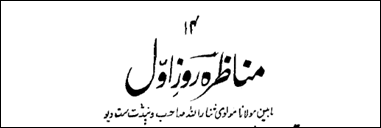
Munazira: First Day
between Maulana Maulvi Sanaullah sahib and Pandit Sat Dev
Displayed below is the top part of page 24. Its heading is as follows:
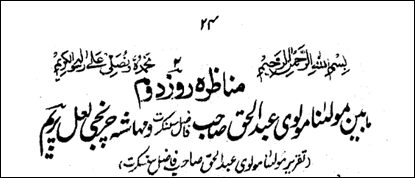
Munazira: Second Day
between Maulana Maulvi Abdul Haq Vidyarthi, scholar of Sanskrit, and
Mahasha Charanji Lal Prem
Maulana Sanaullah’s unwise reply to an Arya debater
One anecdote Maulana Abdul Haq Vidyarthi used to relate to us was that, in some debate, the Arya speaker asked Maulana Sanaullah: “If Allah is all-Powerful, can He create another God like Himself?” Maulana Sanaullah replied: “Yes, Allah can do that. But the God He will create will say: I am not the real God, but He is.” Maulana Abdul Haq Vidyarthi used to say: I knew what the Arya was going to say in reply. The Arya said: “It means one of them is telling a lie: if the first God is right that He has created a God just like Himself, then the second God is lying by saying ‘I am not the real God’, and if the second God is right then the first God is lying that He has created a God just like Himself.” Then Maulana Vidyarthi used to explain that the question itself is wrong. By definition, God cannot be created. Moreover, it is an attribute of God that He is One. How can God act to remove His own attribute?
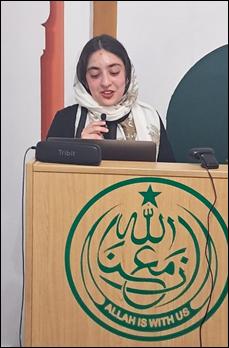
Talk at the UK Lahore Ahmadiyya
Centre, London, 5 July 2026,
by Zainab Nazir
 The Quran’s descriptions of Paradise are among its most
evocative passages. They speak of gardens, flowing rivers, peace,
companionship, and everlasting joy. Yet beneath these vivid images lies a
deeper theological and linguistic richness that invites reflection. Rather than
offering an exhaustive description of the afterlife, the Quran provides
glimpses, enough to awaken longing, while leaving the true reality beyond human
comprehension. This balance between revelation and mystery is perhaps captured
in the very name of Paradise itself.
The Quran’s descriptions of Paradise are among its most
evocative passages. They speak of gardens, flowing rivers, peace,
companionship, and everlasting joy. Yet beneath these vivid images lies a
deeper theological and linguistic richness that invites reflection. Rather than
offering an exhaustive description of the afterlife, the Quran provides
glimpses, enough to awaken longing, while leaving the true reality beyond human
comprehension. This balance between revelation and mystery is perhaps captured
in the very name of Paradise itself.
One distinctive feature of the Arabic language is that words derive usually from triliteral roots, making it distinct from many other languages. These roots carry a central concept from which numerous related words emerge. For example, the root ك ت ب (K-T-B) conveys the idea of writing. From this root, we can derive words such as kataba (he wrote), kitāb (book), maktab (office or place of writing), and maktūb (written). Although these words differ in form and function, they all revolve around the same underlying meaning.
The word Jannah follows the same linguistic pattern. It derives from the root ج ن ن (J-N-N), whose fundamental meaning is to cover, conceal, or hide. This root appears throughout Arabic in words that all preserve this central idea. A jinn is hidden from human sight. A janīn is an embryo concealed within the womb. A majnūn is someone whose intellect has become obscured. The Quran itself employs this root when speaking of the embryo:
ہُوَ اَعۡلَمُ بِکُمۡ اِذۡ اَنۡشَاَکُمۡ مِّنَ الۡاَرۡضِ وَ اِذۡ اَنۡتُمۡ اَجِنَّۃٌ فِیۡ بُطُوۡنِ اُمَّہٰتِکُمۡ
“He knows you best when He brings you forth from the earth and when you are embryos (jinna) in the wombs of your mothers …” (53:32).
Classical commentators explain that Jannah originally referred to a garden so thick with trees and vegetation that the ground itself was concealed beneath its foliage. Such a garden would have held immense significance for the Arabs of the seventh century. Living in an environment characterised by heat, drought, and sparse vegetation, a lush garden represented shade, water, abundance, and life itself.
Yet the appeal of this imagery is by no means confined to the Arabian Peninsula. The Quran addresses the Arabs to whom it was first revealed, but its message is universal. Across cultures and throughout history, gardens have symbolised beauty, tranquillity, and renewal. Modern psychological research likewise suggests that exposure to green spaces can significantly improve mental wellbeing. The Quranic imagery therefore resonates with something deeply human and innate. A flourishing garden naturally evokes security, nourishment, and peace, qualities that mirror the eternal serenity of Paradise.
The notion of concealment, however, extends beyond the etymology of the word itself. The Holy Prophet Muhammad narrated that Allah says:
“I have prepared for My righteous servants what no eye has seen, no ear has heard, and what has never occurred to the human heart” (Bukhari, hadith 3244, 4780 and 7498)
This famous hadith offers a profound lens through which to understand Paradise. Although the Quran provides vivid descriptions, these descriptions are necessarily limited by human imagination. The reality of Paradise remains concealed, because it surpasses every category through which we understand beauty and happiness — it is simply beyond our capacities to understand. Allah reveals enough that believers long for it, but withholds enough that its true splendour remains beyond comprehension. This concealment may itself be understood as an act of mercy, preserving the awe and transcendence of the Divine promise.
Among all the Quran’s depictions of Paradise, none is repeated more frequently than that of gardens beneath which rivers flow. Allah says:
وَ بَشِّرِ الَّذِیۡنَ اٰمَنُوۡا وَ عَمِلُوا الصّٰلِحٰتِ اَنَّ لَہُمۡ جَنّٰتٍ تَجۡرِیۡ مِنۡ تَحۡتِہَا الۡاَنۡہٰرُ
“And give good news to those who believe and do good deeds, that for them are Gardens in which rivers flow” (2:25).
This pastoral imagery is striking, not merely for its beauty but for what it symbolises. Gardens represent flourishing life, while flowing rivers signify continual provision and abundance. Nothing is barren, exhausted, or depleted. Every element points towards permanence and Divine generosity.
Yet the Quran’s portrayal of Paradise cannot be reduced to material abundance. The emphasis repeatedly extends beyond physical pleasures to existential fulfilment. One of the most significant recurring expressions is خَالِدِينَ فِيهَا أَبَدًا — khālidīna fīhā abad-an: “abiding therein forever.” The word khālidīn conveys permanence and continuous dwelling, while abad-an removes any possibility of an end, strengthening the concept of eternity. This everlasting nature of Paradise stands in deliberate contrast to the fleeting character of worldly life.
Indeed, Allah swears by time itself:
وَ الۡعَصۡرِ ۙ﴿۱﴾ اِنَّ الۡاِنۡسَانَ لَفِیۡ خُسۡرٍ ۙ﴿۲﴾
“By the time! — Surely man is in loss” (103:1–2).
Time is among humanity’s greatest limitations. It diminishes youth, weakens strength, separates loved ones, and ultimately ends every earthly life. Every passing moment carries eternal significance precisely because it cannot be recovered. In Paradise, however, time is no longer a limiting factor. There is no decay, no ageing, no grief over what has been lost. Eternity itself becomes one of the greatest blessings.
Equally significant is the Quran’s emphasis on peace — not merely peace from hardship, but peace in every human interaction. Allah describes the inhabitants of Paradise:
لَا یَسۡمَعُوۡنَ فِیۡہَا لَغۡوًا وَّ لَا تَاۡثِیۡمًا ﴿ۙ۲۵﴾ اِلَّا قِیۡلًا سَلٰمًا سَلٰمًا ﴿۲۶﴾
“They hear therein no idle or sinful talk — but only the saying, Peace! Peace!” (56:25–26).
This image contrasts sharply with human experience in the present world. Much of earthly suffering arises not only from physical pain but also from words: arguments, slander, gossip, lies, resentment, and broken relationships. Paradise is depicted as a community purified from such harms. Every greeting is one of peace, every conversation free from sin. The Quran reinforces this contrast by depicting the inhabitants of Hell disputing and blaming one another, as seen in Sūrah Ṣād (38:64). The absence of conflict in Paradise therefore becomes one of its defining characteristics.
Ultimately, however, even these magnificent descriptions are not presented as the greatest reward awaiting the believer. Again and again, after describing Paradise, the Quran points beyond it to something greater still: the pleasure of Allah.
وَ رِضۡوَانٌ مِّنَ اللّٰہِ اَکۡبَرُ
“And greatest of all is Allah’s goodly pleasure” (9:72).
This verse reframes the believer’s understanding of Paradise. The gardens, rivers, fruits, and palaces are extraordinary gifts, but they are not the highest objective. The highest and most desirable honour is that Allah is pleased with those who enter Paradise.
In this sense, the theme of concealment returns one final time. Allah belongs to al-ghaib, the unseen. Human beings cannot perceive Him directly in this worldly life, yet every act of worship is directed towards Him. Perhaps, then, the deepest meaning of Jannah lies not simply in its beauty, but in the nearness it represents. Paradise is ultimately the fulfilment of a relationship: the eternal reward of those who sought their Lord in faith, trusted Him without seeing Him, and lived in pursuit of His pleasure. The greatest joy of Paradise is therefore not only where one is, but Whose pleasure one has attained.
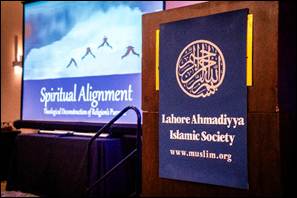
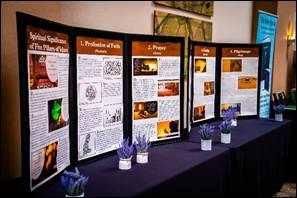
The 2026 Annual Convention of the Lahore Ahmadiyya Islamic Society (USA) was held in Dublin, Ohio, USA, from Friday July 24 to Sunday July 26. We will publish further details of this international event in our next issue. Here we display two photos from it.
E-mail: islamic-view@ahmadiyya.org
For books on Islam and the Ahmadiyya Movement, please visit our websites:
(in Indonesian)
Read a selection of Lahore Ahmadiyya literature on the website archive.org at the link: http://bit.ly/4ok2NTj