© Ahmadiyya Anjuman Lahore Foundation (UK)
In the Name of Allah, the Beneficent, the Merciful
The Islamic View
Patron: Mr Nasir Ahmad · Editor: Dr Zahid Aziz

Worldwide Lahore Ahmadiyya Movement
A Magazine of the Central Ahmadiyya Anjuman, Lahore
Available online at: www.jamaat.uk/islamic-view
July 2026 · Vol. 2, No. 7
Contents
Truthfulness of Abraham, and of all prophets
Friday khutba for Lahore Ahmadiyya UK, 5 June 2026, by Dr Zahid Aziz
Life-sketch of Hazrat Maulana Nur-ud-Din
Published at the time of his death
Ahmadiyya Community as it was during the era of Hazrat Maulana Nur-ud-Din
by Hazrat Maulana Sadr-ud-Din
Devotion to Allah is above devotion to your spiritual leader
Quoting, or misquoting, the Quran
A researched compilation by Zahid Aziz
Hazrat Ameer Dr A.K. Saeed in the UK
Friday khutba for Lahore Ahmadiyya UK, 5 June 2026,
by Dr Zahid Aziz
وَ مَاۤ اَرۡسَلۡنَا مِنۡ قَبۡلِکَ مِنۡ رَّسُوۡلٍ اِلَّا نُوۡحِیۡۤ اِلَیۡہِ اَنَّہٗ لَاۤ اِلٰہَ اِلَّاۤ اَنَا فَاعۡبُدُوۡنِ ﴿۲۵﴾ وَ قَالُوا اتَّخَذَ الرَّحۡمٰنُ وَلَدًا سُبۡحٰنَہٗ ؕ بَلۡ عِبَادٌ مُّکۡرَمُوۡنَ ﴿ۙ۲۶﴾ لَا یَسۡبِقُوۡنَہٗ بِالۡقَوۡلِ وَ ہُمۡ بِاَمۡرِہٖ یَعۡمَلُوۡنَ ﴿۲۷﴾
“And We sent no messenger before you but We revealed to him that there is no God but Me, so serve Me. And they say: The Beneficent has taken to Himself a son. Glory be to Him! No, they are honoured servants — They do not speak before He speaks, and according to His command they act.” — The Quran, ch. 21, Al-Anbiyā’, vv. 25–27
وَ مَا کَانَ لِنَبِیٍّ اَنۡ یَّغُلَّ ؕ وَ مَنۡ یَّغۡلُلۡ یَاۡتِ بِمَا غَلَّ یَوۡمَ الۡقِیٰمَۃِ ۚ ثُمَّ تُوَفّٰی کُلُّ نَفۡسٍ مَّا کَسَبَتۡ وَ ہُمۡ لَا یُظۡلَمُوۡنَ ﴿۱۶۱﴾
“And it is not for a prophet to act dishonestly. And whoever acts dishonestly will bring his dishonesty on the day of Resurrection. Then shall every soul be paid back fully what it has earned, and they will not be wronged.” — ch. 3, Āl ‘Imrān, v. 161
In the first set of verses I recited, verse 25 informs us that all prophets before the Holy Prophet Muhammad received revelation from God, teaching them that there is no God other than Him, and that they, the prophets, should serve and worship Him only. And, of course, the Holy Prophet Muhammad also received the same revelation and teaching. Then verse 26 tells us that, because there is only one God, it is wrong to say that He has a son. This is because a son is always of exactly the same kind, genus and species as the father. In fact, in any species a son goes on eventually to replace the father. This verse says that all prophets are servants of God, but held by Him in honour. Then verse 27 says: “They do not speak before He speaks, and according to His command they act”, meaning that whatever they teach in their preaching, even when it is in their own words, it comes from God, not from themselves, and that they always act upon His commands. This establishes a doctrine known as the sinlessness of the prophets: that both their words and their actions conform to the teachings they have been given by God. The mention in the previous verse, verse 26, of the wrong belief of some people that God has a son, also has a connection with the doctrine of the sinlessness of the prophets. Christians also hold that Jesus was the only sinless one to appear on earth. But this is refuted here by saying that, in fact, all prophets acted exactly according to God’s commands in their words and deeds.
The second passage I recited speaks more specifically about the sin of dishonesty, saying that no prophet can act dishonestly towards people. In other English translations of the Quran, instead of “act dishonestly”, words such as “deceive”, “defraud”, and “act unfaithfully” have been used. In the Quran, the description “truthful” (ṣiddīq) is also applied to some prophets by name: Joseph, Abraham, Ishmael, and Idris (12:46, 19:41, 19:54, and 19:56). Mary is likewise called ṣiddīqa (5:75). In chapter 26 of the Quran, each of five prophets, including Noah, has been called rasūl-un amīn-un or “a faithful messenger”. We know that our Holy Prophet Muhammad was declared even by his opponents as both truthful and trustworthy, aṣ-Ṣādiq al-Amīn.
As I just indicated, the Quran clearly states about Abraham: “And mention Abraham in the Book: اِنَّہٗ کَانَ صِدِّیۡقًا نَّبِیًّا — “Surely he was a truthful man, a prophet” (19:41). Yet according to a hadith in Bukhari, the Holy Prophet said:
لَمْ يَكْذِبْ إِبْرَاهِيمُ عَلَيْهِ السَّلاَمُ إِلاَّ ثَلاَثَ كَذَبَاتٍ
“Abraham did not tell a lie except on three occasions” (hadith 2217, 3358, 5084).
This statement is also in other books of Hadith and is commonly accepted in Islamic literature. Those three occasions of lying are then mentioned in these hadith. Of course, it is stated in the hadith that he lied for a noble purpose, “for the sake of Allah”, and not for any selfish gain. There is an English translation of the Quran, entitled The Noble Quran, by Dr Al-Hilali and Dr Muhsin Khan, which is published by the authorities in Saudi Arabia and officially-endorsed. In this translation they have quoted this hadith in full in a footnote (under 16:121), as if to announce to the world that Abraham lied three times. However, Maulana Muhammad Ali, in his Urdu translation of Sahih Bukhari, has commented on this hadith as follows:
“Any hadith which contradicts the Quran cannot be accepted. The Quran calls Abraham as ‘a truthful man, a prophet’. According to classical Arabic dictionaries, ṣiddīq is one who has reached perfection in telling the truth, whose truthfulness has been demonstrated abundantly, and who has never told a lie; one who is so used to speaking the truth habitually that he cannot tell a lie. Everyone under normal circumstances speaks the truth. A person’s being truthful is only established when he is in a difficult position. According to this hadith, on these three occasions Abraham would have faced problems by speaking the truth, so he told a lie, they allege. This is highly insulting and derogatory to the dignity of a prophet. … But our Ulama cannot bear to accept that a reporter of hadith could have made a mistake, yet they are ready to accept that a prophet could have told a lie whom the Quran gives the title of ṣiddīq. I see no reason why this hadith should not be rejected” (Faḍl-ul-Bārī, under hadith 3357).
The first of those three occasions is mentioned in some detail in this hadith. But that incident is not to be found in the Quran. It occurs in the Bible; in fact, according to the Bible it happened twice in two different places (Genesis, ch. 12 and ch. 20). What its narration amounts to is this. Abraham and his wife Sarah (mother of Isaac) were in a foreign land, out of their own country, ruled by a tyrant. Abraham was afraid that, as his wife was beautiful, the tyrant might have him killed and marry her. So Abraham told people that she was his sister. This is the alleged lie told by Abraham. Abraham also asked his wife to back up his lie. The tyrant then took Sarah as his wife, but God sent, or threatened to send, punishment on the tyrant, so he gave up and returned the wife to Abraham. According to this incident as presented, whether in the Bible or in Hadith, Abraham told a lie to save his own life, so that the tyrant would not kill him to marry her. Instead, he put his wife in danger at the hands of the tyrant, who would marry her and treat her in any way he wanted. There is an article about these stories written in 2024 by a professor of the Bible at Hebrew College in the USA, Rav Rachel Adelman, on her college’s website. Of course, she is a believer in the Bible. She writes:
“How could our forefathers endanger their wives to preserve their own lives? It seems hardly humane, let alone ‘manly’! … Abraham’s sin was not just ‘the lie’, endangering Sarah’s integrity, or his lack of faith in God, but also his distrust of the local inhabitants” (see link).
Sadly, this opinion is the result of accepting the misportrayal of Abraham in the Bible.
In the two stories as related in the Bible, when the tyrant or king in question realises that the woman he has married is Abraham’s wife, he protests to Abraham, saying: “Why did you say, ‘She is my sister?’ so that I took her for my wife” (Genesis, 12:19); and: “What wrong had I done to you that you brought this guilt on me?” (Genesis, 20:9). It is the two tyrants, supposedly cruel rulers, who turn out to be the innocent party, misled by Abraham. And they both behaved well in letting Sarah go back to Abraham. It is utterly unbelievable and absurd that the man of God tells a falsehood, while the tyrant cannot be faulted for marrying a woman he thought was unmarried, and he must be praised for letting Abraham’s wife go back to him in a just and decent way upon finding out. No version of this story, whether as reported in Hadith or as given even more absurdly in the Bible, can be accepted because it is based on the allegation that Abraham told a lie in order to save his life.
The two other so-called lies mentioned in that hadith are in connection with Abraham’s preaching against idolatry as related in the Quran. Abraham had been arguing with his people about the falseness of the gods that they worshipped. The Quran says:
“Then he glanced a glance at the stars, and said: Surely I am sick (of your deities). So they turned their backs on him, going away” (37:88–90).
It is claimed that Abraham’s people were going to some pagan festival but Abraham didn’t want to join them, so he made the false excuse, saying “I am sick”, so that he could remain behind and break the idols in their temple. In the Saudi Arabian official English translation of the Quran that I mentioned above, it is added in brackets after “I am sick”: “He did this trick to remain in their temple of idols to destroy them and not to accompany them to the pagan feast.”
Maulana Muhammad Ali, in his Urdu commentary of the Quran, Bayan-ul-Quran, writes:
“To say that Abraham lied in the way of Allah is absurd. The way of Allah and an evil deed cannot go together. … it is not allowed to tell a lie in order to get the opportunity to smash an idol. The mention of Abraham glancing at the stars before saying ‘I am sick’ shows that the meaning is ‘I am sick of what you worship’ because his people also worshipped stars” (see under verse 37:89).
But Muslim scholars of the Quran, of olden times, took Abraham’s statement, “I am sick”, literally, and constructed an imaginary story around it.
Most Muslims know the incident from the Quran that, while the idol-worshippers were not present, Abraham broke all their idols except for the chief idol. When they returned and asked him: “Have you done this to our gods, Abraham?” (21:62), he is said to have replied:
“No, it was this, the chief of them, who has done it. So ask them (i.e., the idols), if they can speak” (21:63).
This is said to be the third lie told by Abraham, to say to his people that the chief idol has broken the other idols. Now a lie is something which the hearers can believe. If Abraham had named some person and said he has broken them, that would be a lie. To mention to people what they know is impossible cannot be called a lie. If Abraham did say this, he was trying to put the idol-worshippers to shame, that their chief idol has no power to break his subordinate idols.
Maulana Muhammad Ali is almost the only translator of the Quran who has shown that these words of Abraham ought to be translated as: “Indeed someone has done it. This is the chief of them. So ask them, if they can speak.” According to this translation, Abraham did not say that it was the chief idol who broke the other idols.
This issue of the sinlessness of the prophets is one about which Hazrat Mirza Ghulam Ahmad and our Lahore Ahmadiyya scholars have written in detail and corrected the errors that crept into the beliefs of the Muslims on this point by believing silly and baseless stories. Let us pray that Allah makes their correct interpretation spread widely. Ameen.
Note: The audio form of this khutba is available at the following link:
www.youtube.com/watch?v=VhVWHNHjD-U
Published at the time of his death
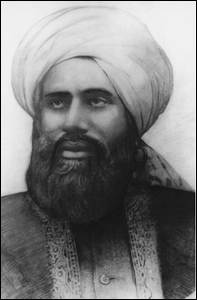
[Reproduced below is the obituary of Hazrat Maulana Nur-ud-Din which was published in the Review of Religions, the monthly English journal of the Ahmadiyya Movement, in its April 1914 issue, pages 143–148. All spellings of names in the reproduction below are as in the original article.]
The Late Hazrat Moulvi Noor-ud-din
It is with profoundest regret that we announce the death of His Holiness Hazrat Moulvi Noor-ud-din Sahib, the first Successor of the Promised Messiah. He was about seventy-four years of age and had been confined to bed for several weeks. He left this world while offering his midday prayer on Friday the 13th March at about 2 p.m. He was the leader of the Ahmadiyya community and in his death not only have his followers lost their spiritual father but the world has lost one of the greatest saints of the age. His loss was bewailed not only by his followers and co-religionists but by Sikhs, Aryas, Hindus and others. Numbers of Sikhs and Hindus followed his dead body to the grave. He was well-known throughout the country not only for extraordinary piety, but for the depth and width of his learning, variety of experience, and skill as a great physician. Indeed he was a combination of the saint, the scholar, the physician, and the philanthropist. Few such personages appear in centuries.
In him was found that width of learning, that variety of experience, that deep knowledge of human nature, that practical sense, that independence of spirit, that simplicity of heart, and above all that unbounded love for God and His creatures, which you will not find in any other living man in the whole world.
Moulvi Noor-ud-din was born at Bhera, in Shahpur district in the Punjab, in 1258 Hijri or 1841 A.D. He was a direct descendant of Hazrat Omar, the second successor of the great Arabian Prophet. When yet a child, he learnt the Holy Quran from his mother. Here he imbibed that love for the holy book which afterwards became a passion with him. Then he read Arabic and Persian at home under several teachers who fortunately knew the art of teaching and did not spoil his brain by simply memorising as was the custom with the Ustads (teachers) of the time. His faculties were thus well developed till his youth when he joined the Normal School at Rawal Pindi. There he took first class certificate in the final examination and was appointed as Headmaster of the Pind Dadan Khan Middle Vernacular School. While there, once an Inspector came to visit the school. He could not find any fault with his work. But Noor-ud-din did not know flattery which inspecting officers are generally used to and fond of. His straight-forward manner of speaking annoyed the officer. He very seriously remarked: “You appear to be proud of your first class certificate.” The moulvi took the certificate from his pocket and tore it off and said: “This is not my God. I care little for this certificate or this service.”
Then he resigned his post and went to Lahore where he studied Persian and the Unani System of Medicine. In order to complete the study of Medicine he went to Lucknow and sat for three years at the feet of Hakim Ali Hosain, a celebrated physician of the time. He also studied Hadis, Fiqah, Mathematics, Euclid, and Algebra there with several other teachers and became well-versed in all these branches of study.
When he was just thinking of leaving Lucknow, the Nawab of Rampore sent for Hakim Ali Hussain, who took Moulvi Noor-ud-din with him. He studied there for some time and then went to Bhopal for the study of Islamic theology. Then he went on a pilgrimage to Mecca, visited Medina, and travelled in Arabia for the acquisition of knowledge.
On his return to India he opened a dispensary at Bhera, his native place, and proved a very successful physician, but he cared more for religion than for anything else, and his was a mind not to be fettered with opinions of the learned divines of the past on questions of faith and religious practice and so the mullahs of the dogmatic school became his bitter enemies. Here began the religious struggle which continued to his last days. Everywhere he got the better of his opponents with his learned and forcible arguments. When he had lived for some years at Bhera, an officer of the Kashmere Raj who belonged to Bhera fell ill, came home and was treated by Hakim Noor-ud-din. He was so pleased with the Hakim’s mode of treatment that when he went back to Kashmere he recommended him to the Maharaja who appointed him to be his family physician. Moulvi Noor-ud-din’s learning, piety, and exemplary character won the respect and admiration of the Maharaja as well as the members of his Durbar (Court). His door was always open to strangers, students, and the poor. His own mode of living was the simplest possible. He had no separate dress for the Durbar, and even on special occasions he did not wear gala dress. His fare was also as simple as that of a quite ordinary man. Every day he used to dine with his poor guests. But he was a great lover of books, for which he spent money like water.
When the Maharaja of Kashmere died he went back to Bhera and again settled there and began a splendid building for his residence.
Now comes the turning point of his life. While at the Kashmere Durbar he heard of Hazrat Mirza Ghulam Ahmad Sahib and at once started for Qadian to see him. He was a great admirer of Mirza Sahib for his deep piety and burning love for the religion of Islam. Moulvi Noor-ud-din knew that Mirza Sahib was often blessed with revelations from God and that a simple and unostentatious man like him could not be a hypocrite. So when Hazrat Mirza Sahib claimed to be the Promised Messiah and Mahdi in obedience to some commandments which were revealed to him by God, Moulvi Noor-ud-din was the first man to accept him, and from that day he identified himself with the movement started by Mirza Sahib and wrote to him that he was ready to sacrifice his life and property. Later on he removed to Qadian, and both the master and the disciple had such a deep love for each other that they could not think of separation anymore. Henceforth he devoted all his powerful energy to the service of Islam by writings, speeches, conversations, teaching of the Quran, and prayers. Like his great master he submitted entirely to God and whatever he did he did for His sake. The Quran he believed to be the very Word of God containing in a comprehensive manner the loftiest teachings of all the revealed books of the world and sufficient for the highest development of man — individual and social, moral and spiritual. So his love for the holy book knew no bounds. He was never tired of teaching it. He used to say that it was his food, the element in which he lived. Even on his death-bed when he could scarcely move his hands and feet he felt a new life when he heard the Quran. He lived in an atmosphere of the Quran and created a love for it in men and women, old and young, learned and ignorant. The whole Ahmadiyya community is surcharged with the spirit of the Quran. Even the labourers of Qadian can explain the Quran in a way which extorts admiration from learned Arabic scholars outside this little village.
He, however, not only taught the Quran but he himself practised its teachings and enjoined others to do so. “Simply learning is of no use,” he used to say. “Practice is the thing necessary.”
His love of God found an expression not only through his love of the Quran but through all the commandments of Islam. He was constant at namaz or obligatory prayers and remembered God in every breath. He had the most perfect conviction in the efficacy of prayer. Those who were around him know very well how his prayers were wonderfully accepted by the Almighty Allah. He received hundreds of applications for prayers from his followers and others and he was never tired of supplicating the Merciful Allah for the sake of others. His mind was as open as nature itself. He saw the expression of the Divine will not only through His revealed book but through nature and the history of nations. So he studied the history of various nations. He also studied modern European science and philosophy through translations in Arabic. His library has a wonderful collection of rare books on religion and history. He did not care for books which can be easily had. He read them and then distributed them among poor students. But he took particular care in collecting rare books and spent thousands of rupees for this purpose. There are three libraries in India famous for Arabic and Persian books: at Bhopal, Rampur, and Bankipur, but Moulvi Noor-ud-din’s library will yield to none so far as valuable and rare books on history and religion are concerned. His thirst for knowledge continued even to his last days. A few days before his last illness he said that he had just finished two volumes of Charak and Sasrut — books on the Indian system of medicine comprising some three thousand pages.
He devoted all he could get for helping the poor, the needy, poor students, and other works for the service of Allah. He gave in charity like a prince, but himself lived like a beggar. His dress as well as his food was of the simplest kind. He often used to say: “Some of my friends tell me: you do not save anything; you have wife and little children; how will they be maintained after your death? I tell them: God is Living, not dead; He is Omniscient; if I serve Him, will He not look after my family?” A few days before his death he made a will in which he stated: “My children are very young; God is their Protector; there should be no charity fund for their maintenance. Let there be some ‘Karz Hasna’, i.e., unconditional loan which should be paid off by the ablest among the sons.” What a living faith, what a trust in God are expressed through these words? Such words can be uttered by those only who love God and feel the presence of God in every breath.
He was so industrious that it appeared he found comfort in work and work only. He was endowed with an exceptionally strong physique and from youth to old age he worked like a giant. Even to his last days he taught the Quran and attended patients. But there was no feverishness in his activity. It was like the smooth flow of a mighty river, never hurrying, never stopping, always going on. There was a calm serenity in his countenance, no hurry, no worry, no weariness. In the midst of his manifold activities he was always cheerful, smiling, never losing his temper. One day, surrounded by a crowd of patients and followers and very busy in writing letters, his little son came and upset the inkpot and spoiled many letters and papers with ink; he simply told him: “Just see, my boy, what you have done.” The little boy, quite young though he was, hung his head with shame.
His spirit of independence was worthy of himself. He said and did what he thought right and never cared for the opinions of others. While he was in the Court of the Maharaja of Kashmere, he always spoke without any hesitation what he thought proper and never shrank from giving expression to his real feeling. Yet this very Noor-ud-din who was a lion in the courts of princes was meek as a lamb in the presence of the Promised Messiah, his spiritual guide. He sat at a little distance and never raised his head, nor looked his master in the face. The Promised Messiah in his turn loved him more than any other disciple and fervently prayed for him and wrote pages after pages in his praise.
Moulvi Noor-ud-din succeeded the Promised Messiah in 1908 and became the leader of the community founded by him. He had many difficulties as the spiritual head of the movement but he guided his followers with strength, wisdom, patience and tact. As the successor of the great world teacher his one and only aim was to make his followers the true servants of God. The world, the civilised world, has lost faith in the Unseen and is sunk in materialism. This saint tried to turn his followers into true Muslims who would be entirely of God and of no other and would hold aloft the torch of faith before the world. He sent missions to foreign countries, the most prominent of these being the one sent to England, headed by Khawaja Kamal-ud-din, B.A., LL.B., which has done immense good by removing many of the prevailing misrepresentations against Islam and has succeeded in gaining a number of converts in high spheres of society.
It is not possible for ordinary mortals to fathom the depth of a sage like this Moulvi. Like his masters, the Promised Messiah and the Prophet of Arabia, he was in this world and yet not of this. He had a wife and children and no husband was more loving, no father more affectionate, yet his heart was always with God. Neither honour nor disgrace, neither wealth nor poverty, neither the company of intimate friends nor the loss of a dear son could ever for a moment disturb his soul. He had perfect assurance of the beneficence of Allah and cheerfully accepted everything from Him, were it bitter or sweet. His soul was like a mountain rising high above the clouds so that thunder and lightning, smoke and dust could never reach its top which smiled in eternal sunshine. In short, his whole life was an illustration of the following verse of the Holy Quran:
“It is no virtue that you turn your faces towards the East or the West, but virtue is of him who believeth in God and the afterlife and the angels and the prophets; and giveth wealth for the love of God unto his kindred and the orphans and the needy and the wayfarers and beggars, and for the release of captives, debtors and slaves; and who observeth prayers, and giveth legal alms; and of those who perform their covenant which they have covenanted; and who are patient in poverty, disease and adversity and in time of fight; these are those who are truthful to their Lord and these are those who are righteous” [2:177].
MUBARAK ALI
[We translate below an article written by Hazrat Maulana Sadr-ud-Din in Paigham Sulah, the Silver Jubilee issue, dated 17 December 1938 (p. 20). His impressions of Hazrat Maulana Nur-ud-Din, given hereunder, are based on his personal observations and experiences, as he had served in Qadian as Headmaster of the Ahmadiyya Talim-ul-Islam High School from 1910 to 1914 during the period of Hazrat Maulana Nur-ud-Din’s leadership. He was also Secretary of the Sadr Anjuman Ahmadiyya at the time of the Hazrat Maulana’s death in March 1914. He also helped to nurse Hazrat Maulana Nur-ud-Din daily during his last illness, feeding him by hand. Hazrat Maulana Sadr-ud-Din was later Head of the Lahore Ahmadiyya Jama‘at from 1951 to 1981, and has several other magnificent services to his credit which are beyond the scope of this brief note.]
The era of Hazrat Maulana Nur-ud-Din, may Allah grant him mercy and forgiveness, evoked memories of the age of the Companions of the Holy Prophet Muhammad. Within the Ahmadiyya Jama‘at, there was an extraordinary enthusiasm for the study and teaching of the Holy Quran and the Hadith because Maulana Nur-ud-Din himself practised every aspect of Islam with profound devotion and zeal, which led to the members of the Jama‘at in Qadian in particular, as well as more generally in the branches of the Jama‘at outside Qadian, being fervent in the observance of the commandments of the religion.
Maulana Nur-ud-Din’s love for the Holy Quran defies description in words. He delivered talks on the Quran in public and also conducted classes for women in his home. Sometimes he would hold teaching sessions for young people as well. In general, he spent very little time within the confines of his home. Most of the valuable hours of his life were spent with the people outside. Whether he was attending to patients in his medical practice or outside the hours of his practice, he was always addressing religious matters. His explanations were so inspiring and appealing, and so much in support of the religion of Islam, that people gathered around him in large numbers and were reluctant to leave his company.
One of the most distinctive features of his life was his deep concern for the poor and underprivileged. In the truest sense, he was a benefactor of the needy. Whether it was a young child, an adult, a widow, or any person afflicted by hardship, his hand was always ready to assist, and his heart was moved by their suffering. He often remarked that caring for the poor, the distressed, and the sick was a means of attaining the pleasure of God. It was rare for his household not to be providing care for an orphaned boy or girl. Many orphaned children also received education in the school in Qadian. He paid close attention to their welfare and repeatedly instructed the headmaster and teachers to treat them kindly. Even when these children committed mistakes or were blameworthy, he would never be happy to punish them, as his nature was filled with compassion and mercy.
A spirit of generosity permeated all of Maulana Nur-ud-Din’s teachings and actions. There was not the slightest trace of prejudice in his character. His benevolence extended not only to Muslims but also to Hindus and Sikhs. According to him, one who worships the Lord of the worlds (Rabb-ul-‘ālamin) cannot harbour prejudice against any of His creatures. The Jama‘at benefitted from this because it made people throughout India, and especially in the Punjab, feel drawn towards him, and by his presence, his conduct, and his dealings with others, countless objections that people had harboured against the Movement were automatically dispelled. This was a great service rendered through his existence. It is an undeniable fact that during his tenure the Movement advanced rapidly, gained wider acceptance, and saw a decline in the opposition to it.
Members of the Movement as well as those who were not connected with it took full advantage of his medical practice. No one ever felt that Maulana Nur-ud-Din adopted a narrow-minded or biased attitude towards any section of the Muslim community. Not only Muslims, but Hindus and Sikhs also benefited to the full from his kindness and benevolence. The Hindus of Qadian, in particular, regarded his presence as a protective Divine shield over them. It became firmly established in people’s minds that he was genuinely devoted to humanity and that he regarded service to God’s creation as an essential aspect of Islam.
The zeal for religion that characterized Maulana Nur-ud-Din’s own temperament lit a spark in the hearts of the Jama‘at members in Qadian, and its influence extended powerfully to beyond Qadian as well. People from within and outside Qadian regularly gathered to see him to acquire religious knowledge. This became a source of fame and noble reputation for Qadian and created among Jama‘at members a spirit of religious observance, integrity in worldly dealings, and righteousness. He frequently emphasized that the influence of religion should be visible in every aspect of our lives. Another point on which he laid great stress was that a Muslim should always turn to God in prayer concerning every matter. He never tired of emphasizing this. As a result, not only adults but even small children would pray earnestly and with tears in their eyes. A widespread conviction developed within the Jama‘at that God hears the prayers of believers and that every difficulty could be overcome through supplication. This was a particularly special distinction that Maulana Nur-ud-Din instilled throughout the Jama‘at.
During his lifetime and with his advice, Khwaja Kamal-ud-Din travelled to England for the propagation of Islam. Whenever news arrived that someone in England had embraced Islam, Maulana Nur-ud-Din would express great joy, and this expression of delight had a profound effect on those around him. It is worth noting that any leader who takes such a personal interest in the work of his associates and values their successes contributes significantly to strengthening and consolidating his community.
It was also during his tenure, and at his direction, that Maulana Muhammad Ali began work on the English translation of the Holy Quran, followed later by its Urdu translation. Maulana Nur-ud-Din personally listened to approximately twenty-six parts (juzʾ) of this translation. He would listen to it daily as a form of intellectual and spiritual nourishment. Owing to his profound scholarship, he frequently gave valuable advice and suggestions when necessary. Whenever Maulana Muhammad Ali succeeded in resolving a particularly difficult passage, Maulana Nur-ud-Din would express great pleasure and appreciation.
In summary, the personality of Maulana Nur-ud-Din, through his piety, Quranic scholarship, love of Islam, and high morals, revived memories of the times of the Companions of the Holy Prophet. During his period of leadership, the Jama‘at made great progress in every respect, became firmly established, and many notable efforts were undertaken to disseminate the teachings of the Holy Quran throughout the world. Furthermore, in his time there was a marked zeal in members of the Jama‘at to serve the religion of Islam and to serve humanity. May the countless mercies of God be bestowed upon him!
It is well-known that Hazrat Maulana Nur-ud-Din, while a great scholar of Islam in his own right, and held in high esteem by the general Muslims outside the Ahmadiyya Movement, was also utterly devoted to Hazrat Mirza Ghulam Ahmad as his spiritual mentor and obeyed him implicitly. Yet his obedience and reverence of the Promised Messiah did not lead him to place his mentor on the pedestal of Divinity, and engage in the kind of blind veneration which, unfortunately, the followers of various Muslim religious Movements display towards their leaders. He was reported to have said the following in a talk in 1909, about a year after becoming the Head of the Ahmadiyya Movement:
“I went to Sialkot. It is my practice that whatever is the subject of a verse of the Quran, I explain that topic. Now if there is no mention in it of Mirza [Ghulam Ahmad sahib], how could I drag it in without reason? Some people [Ahmadis] were offended that I gave such a long address but didn’t even mention Mirza, as if I was trying to please the whole world. It is not only them. I have seen the same in Sufis, followers of Fiqh, and the Ahl-i Hadith, that unless you mention what they like hearing about, they become unhappy and aggrieved. In Kashmir, people walk out of a khutba if the name of Sayyid Abdul Qadir Jilani is not mentioned, and think that the khateeb is a faithless man. …
In the Quran such people are mentioned: “And when Allah alone is mentioned, the hearts of those who believe not in the Hereafter shrink” [the Quran, 39:45]. They do not have faith in the Hereafter, so they are enraged at the mention of the oneness of Allah” (Badr, 22 April 1909, p. 5).
During the last days of Hazrat Mirza Ghulam Ahmad when he was staying in Lahore till his death on 26 May 1908, Hazrat Maulana Nur-ud-Din used to deliver his teaching of the Quran (dars) in the presence of the Promised Messiah. The anti-Ahmadiyya Ulama had set up camp at an open ground close to the house where Hazrat Mirza sahib was staying, and here they gathered every evening to make abusive speeches against him within the hearing of Ahmadis. The following was reported by an Ahmadi correspondent in the Ahmadiyya community newspaper Badr:
“At the end, while lamenting the demise of the decency, seriousness and knowledge of these ulama, I wish to mention that Maulana Maulvi Nur-ud-Din gives religious talks (dars). But can any non-Ahmadi prove that the Maulvi sahib has ever mentioned these opponents in order to abuse them, even indirectly, let alone explicitly? In fact, I can say that he has never mentioned the Promised Messiah in particular” (Badr, 26 May 1908, p. 6).
With reference to the last sentence above, the editor of the Badr added a footnote at this point reiterating the Maulana’s devotion to, and sacrifices for, Hazrat Mirza sahib:
“The love and devotion of the honoured Maulvi Nur-ud-Din sahib for the Promised Messiah is known from the fact that, despite being such a physician who could have earned at least a thousand rupees a month in some large city without difficulty and without advertising himself, and despite being the owner of lands, property and houses, he lives in a village for the sake of the Hazrat Mahdi.…”
But he adds this:
“His love is so strong that no disciple can show the same towards his master. Nonetheless, despite such love, his lecture consists of explaining the greatness of God, showing the ways of attaining righteousness, and proofs of the truth of Islam. If in that context a mention of Hazrat Mirza sahib should arise, then so be it. Otherwise, he is so thoroughly absorbed in explaining the greatness and glory of Allah the Most High that he hardly makes any specific mention of his Imam, let alone that he should mention the opponents and thereby waste his own time and that of his audience. Of course, his conduct is itself powerful evidence of the truth of the Promised Messiah, which is better than a thousand words” (Badr, 26 May 1908, pp. 6–7).
Thus, it was openly known during the life of the Promised Messiah and of Maulana Nur-ud-Din, and the Maulana himself referred to it as well, that he did not much mention Hazrat Mirza Ghulam Ahmad in his talks, lectures, and khutbas. This shows how strongly he adhered to the purest belief in the oneness of God and the teaching to please God only. It dispels the idea that disciples should be sycophantic and flattering towards their leader, as regrettably happened in the Qadiani Jama‘at under their Khalifas since March 1914 and till today.
Hazrat Maulana Sadr-ud-Din has also mentioned his own personal observation of this:
“Hazrat Maulana Nur-ud-Din once said during a khutba in Qadian at which I was present: ‘Some people raise the objection that Nur-ud-Din does not mention Mirza in his khutbas.’ He added that such people are mentioned in the Quran in the words: ‘And when Allah alone is mentioned, the hearts of those who believe not in the Hereafter shrink, and when those besides Him are mentioned, lo! they are joyful’ [39:45]. …
I can still visualise another scene in this very Ahmadiyya Mosque in Lahore. Hazrat Mirza sahib and other notable people of the Ahmadiyya Movement were staying in Lahore. It was Friday. Hazrat Mirza sahib was sitting in the congregation while Hazrat Maulana Nur-ud-Din was delivering the khutba. The Maulana said: ‘An objection is raised against me for not making mention of Hazrat Mirza sahib’s name in my khutbas.’ Saying this, he recited the same verse. Hazrat Mirza sahib was listening to this. His face radiated tranquillity, satisfaction and approval. The whole audience felt that both the mentor and the disciple were in complete agreement on this point” (Paigham Sulah, 29 May 1968, p. 19; The Light, 8 June 1969, p. 7).
Hazrat Mirza Ghulam Ahmad writes in his Arabic book, Sirr-ul-Khilafah, which deals with the concept of Khilafat in Islam, about Hazrat Abu Bakr and Hazrat Umar as follows:
“When they became Khalifas, they did not fill their houses with wealth and treasures, nor did they give their sons and daughters gold and silver as inheritance. No, they returned everything they acquired to the Public Treasury. Nor did they appoint their sons as their Khalifas, as is the way of the worldly people and of those who go astray” (Rūhānī Khazā’in, vol. 8, p. 330, 2nd para.).
Quoting, or misquoting, the Quran
A researched compilation by Zahid Aziz
The motivation for the subject of this article arises from allegations made by the opponents of the Ahmadiyya Movement that Hazrat Mirza Ghulam Ahmad has, in certain places in his writings, quoted verses of the Quran differently from how they actually occur in the Quran. It did not occur to them that, given the enormous number of times he has quoted from the Quran in his books, the examples of alleged misquoting that they can cite are few and trivial. If they were sincere and well-intentioned, and free of malice, they could have attributed it to human error during calligraphy or printing. Here I give some examples from the highest of Islamic authorities, ancient and modern, who have quoted verses from the Quran using wording which differs from the actual text of the Quran.
1. Sahih Bukhari
There is a hadith in Sahih Bukhari, reported by Anas, beginning as follows:
Zaid bin Haritha came to the Prophet (ﷺ) complaining about his wife. The Prophet (ﷺ) kept on saying (to him), “Keep your duty to Allah and keep your wife to yourself” (Hadith 7420; see this link).
However, the words of the Holy Prophet to Zaid as quoted in the Quran, 33:37, are:
“Keep your wife to yourself and keep your duty to Allah.”
To quote the original Arabic words, in the Quran the words of the Holy Prophet are:
اَمۡسِکۡ عَلَیۡکَ زَوۡجَکَ وَ اتَّقِ اللّٰہَ
amsik ‘alai-ka zauja-ka wa ittaqi-llāh
but these are quoted in this hadith in Bukhari as:
اتَّقِ اللّٰہَ وَ اَمۡسِکۡ عَلَیۡکَ زَوۡجَکَ
ittaqi-llāh wa amsik ‘alai-ka zauja-ka
(In the Arabic text we have placed in red the words “keep your wife to yourself”.) In fact, the report here says that the Holy Prophet “kept on” saying this.
Certainly Imam Bukhari himself, if not those persons in the line of narrators through whom he received this hadith, must have known that the order of these words in the Quran is different. As Bukhari, unlike the anti-Ahmadiyya critics, had plain commonsense, he must have realised that people sometimes quote words from the Quran wherein they express exactly the same meaning but in a different way from how they occur in the Quran itself.
2. Shah Ismail Shaheed
My second example is from an Arabic book by Shah Ismail Shaheed (d. 1831), entitled Abaqaat. He was the closest associate of Syed Ahmad Barelvi, mujaddid of the thirteenth century Hijrah. He was martyred alongside the mujaddid in the same battle against Ranjit Singh’s Sikh army. He quotes a verse of the Quran as follows, if we translate it into English:
“And there is not a town (qaryah) but a warner appeared in it.”
The Arabic text in his book is as follows:
wa in min qaryat-in illā khalā fī-hā nadhīr
وَ اِنۡ مِّنۡ قَرۡیَۃٍ اِلَّا خَلَا فِیۡہَا نَذِیۡرٌ
See page 208 (lines 6–7) of the edition published in 1381 A.H. (approx. 1970) by the Al-Madrasa al-Arabiyya al-Islamiyya, Karachi, Pakistan (link to this page at archive.org).
As far as I am aware, there is no verse in the Quran with exactly this text. Shah Ismail Shaheed seems to have the following verse in mind:
“And there is not a people (ummah) but a warner appeared among them” (35:24).
There are other verses in the Quran containing the words “warner” and “a town (qaryah)” which may have been in his mind, which led him to substitute “town” for “people”. We may cite the following:
“And if We pleased, We could raise a warner in every town” (25:51).
“And We never sent a warner to a town but those who led easy lives in it said: We are disbelievers in that with which you are sent” (34:34).
“And thus, We did not send before you (O Muhammad) a warner in a town, but its wealthy ones said: …” (43:23).
There is an Urdu translation of Shah Ismail Shaheed’s book Abaqaat by Maulana Manazir Ahsan Gilani (d. 1956), an Indian Islamic scholar who was Dean of the Faculty of Theology in Osmania University, Hyderabad, India, for twenty-five years. His Urdu translation at this point, if we translate it into English, runs as follows:
“Similarly, in the famous Quranic verse wa in min qaryat-in illā khalā fī-hā nadhīr, ‘there is not a town (qaryah) but a warner appeared in it …” (pp. 401–402; link to this page at archive.org).
Maulana Gilani repeats the Arabic text of the wording from Shah Ismail Shaheed’s book, calling it “the famous Quranic verse”, and then translates it into Urdu. Maulana Gilani did not notice that there is no verse in the Quran of exactly this wording.
I carried out a general Google search for this Arabic wording and came across the website of one Qari Hanif Dar, who is described as Khatib Masjid Markaz Pakistan, Abu Dhabi. He writes at the opening of a short Urdu article:
قرآن خود اعلان کرتا ہے کہ و ان من قریۃ الا خلا فیھا نذیر، کوئی بستی ایسی نہیں گزری جس میں نذیر مبعوث نہ کیا گیا ہو
“The Quran itself declares wa in min qaryat-in illā khalā fī-hā nadhīr: There is not a town (qaryah) but a warner was appointed in it” (see link).
It is most puzzling how two scholars of Islam have missed the fact that there is no verse in the Quran containing exactly these words.
3. M.H. Haykal’s Life of Muhammad
The Life of Muhammad is the English translation of Ḥayāt Muḥammad, a voluminous Arabic biography of the Holy Prophet by the late Muhammad Husein Haykal of Egypt, one of the greatest writers of modern Arabic literature, and a renowned novelist, politician, and journalist. The translation was done by Ismail Raji Al-Faruqi, a reputable scholar of Islam. The following passage occurs in this translation, where I have placed its second half in bold for reference:
The eternal truth is that man does not fulfil his iman until he has desired for his fellow man that which he has loved for himself, and has acted and lived in accordance with the principle, “The worthier among you in the sight of God is the more pious, the more virtuous … Work and realize the good, for God will reckon your achievement” and you will be given exactly what you have earned.
(Edition published by Shorouk International of London and Cairo, 1983; chapter Conclusion in two Essays, Essay II, p. 569).
Given below is the image of the original Arabic extract as it appears in Haykal’s Arabic book on pages 558–559. We have underlined in red the part which we placed in bold above.
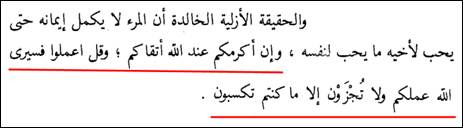
The translator has added a note of his own at this point, referring to the above highlighted words, as follows:
Qur’an, 49:13; 4:106. The author does not quote these words in the manner proper to Quranic words, but uses them as his own — a perfectly permissive literary feature in Arabic. The last part of the sentence not included within quotation marks sounds Quranic in construction and phrasing, but it is not of the Qur’an. — Translator.
(See under Notes and References, note 15 of Essay II, p. 611)
So, M.H. Haykal, the author, has presented a single quotation combining three snippets from different places in the Quran:
(1) The worthier among you …
(2) Work and realize the good …
(3) and you will be given …
The translator Raji Al-Faruqi has commented that this is not the proper manner of quoting from the Quran, but still it is “a perfectly permissive literary feature in Arabic.” In case of the first two snippets, the translator has added the references to the Quran as 49:13 and 4:106. (I should point out that the second reference by the translator is wrong. It should be 9:105, not 4:106.)
As regards the third snippet (and you will be given exactly what you have earned), the translator says it is “Quranic in construction and phrasing, but it is not of the Qur’an.” I think that this third snippet is mixing together of two verses of the Quran. In Haykal’s Arabic book, this snippet is as follows:
Wa lā tujzauna illā mā kuntum taksibūn.
“You will be given nothing except what you have earned.”
There is a verse in the Quran, 36:54, ending with the words:
Wa lā tujzauna illā mā kuntum ta‛lamūn.
“You will be given nothing except what you have done.”
And another verse, 10:52, ending with the words:
Hal tujzauna illā bi-mā kuntum taksibūn.
“You will be given nothing except what you have earned.”
It appears that Haykal has started with the words from 36:54, but after kuntum he has switched to taksibūn, taken from the end of 10:52. If Hazrat Mirza Ghulam Ahmad, in some rare case, quoted from the Quran in the same way, rather than reproducing the verses word-for-word, the same judgment should be made about him as about the great Arab writer M.H. Haykal by his translator, that this is “a perfectly permissive literary feature in Arabic.”
4. Verse of the Quran in the second khutba on Fridays and at Eids
It is well-known that in the second part of the khutba on Fridays and at Eids the following verse of the Quran is recited:
“Surely Allah commands (the doing of) justice and the doing of good (to others) and the giving to the near of kin, and He forbids indecency and evil and rebellion. He instructs you that you may be mindful” (16:90).
The first three words of this verse are:
اِنَّ اللّٰہَ یَاۡمُرُ — Inn-allāha ya’muru
Some people add the pronoun kum, meaning “you”, after this. So the beginning becomes:
اِنَّ اللّٰہَ یَاۡمُرُکُمْ — Inn-allāha ya’muru-kum
This is the form given on the website of a virulently anti-Ahmadiyya organisation in Trinidad, called Darul Uloom Trinidad & Tobago. Now we refer to page 4 of a document on their website at this link. Given below is the image of the Arabic from that page and the image of the transliteration from the next page:
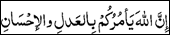

Can we say that by adding kum these people have inserted an extra word into the Quran!
Conclusion
It is a great pity that we have had to waste our time in compiling, analysing, and presenting all these references. But this is imposed on us by the anti-Ahmadiyya propagandists since they are misleading the ordinary, innocent Muslim public by spreading this most serious and grievous false allegation that Mirza Ghulam Ahmad had distorted the text of the Quran.
Hazrat Ameer Dr A.K. Saeed in the UK
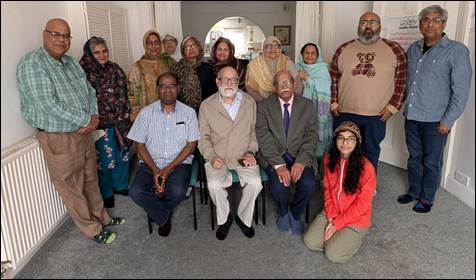
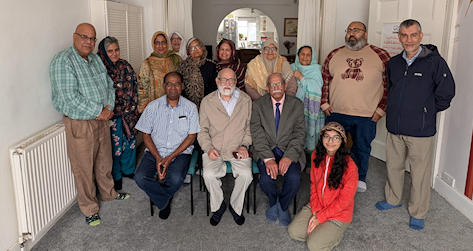
Hazrat Ameer Dr A.K. Saeed was briefly in the UK on a private visit. He graced the Centre of the AAIIL(UK) at Wembley, London, on 7 June 2026 with a visit.
He is seated in the middle in the photo below.
Contact Information
E-mail: islamic-view@ahmadiyya.org
For books on Islam and the Ahmadiyya Movement, please visit our websites:
(in Indonesian)
Read a selection of Lahore Ahmadiyya literature on the website archive.org at the link: http://bit.ly/4ok2NTj