© Ahmadiyya Anjuman Lahore Foundation (UK)
In the Name of Allah, the Beneficent, the Merciful
The Islamic View
Patron: Mr Nasir Ahmad
Editor: Dr Zahid Aziz

Worldwide Lahore Ahmadiyya Movement
A Magazine of the Central Ahmadiyya Anjuman, Lahore
Available online at: www.jamaat.uk/islamic-view/
September 2026 · Vol. 2, No. 9
Contents
The Creation of Pakistan and the role of the Lahore Ahmadiyya Jamaat
Friday khutba for the Lahore Ahmadiyya UK, 14 August 2026, by Dr Zahid Aziz
Felicitations on the establishment of Pakistan
by Maulana Muhammad Ali
Khilafat in Islam did not restart after death of Hazrat Mirza Ghulam Ahmad
From the writings of Hazrat Mirza Ghulam Ahmad
Simplicity of the life of Hazrat Abu Bakr
From The Early Caliphate by Maulana Muhammad Ali
Hazrat Mirza Ghulam Ahmad and Allama Dr Sir Muhammad Iqbal
Meeting of the Council of Imams in Berlin
by Amir Aziz, Imam, Lahore Ahmadiyya Berlin Mosque
Lahore Ahmadiyya Islamic Society Convention
Friday khutba for the Lahore Ahmadiyya UK, 14 August
2026,
by Dr Zahid Aziz
وَ اِذۡ قَالَ مُوۡسٰی لِقَوۡمِہٖ یٰقَوۡمِ اذۡکُرُوۡا
نِعۡمَۃَ اللّٰہِ عَلَیۡکُمۡ اِذۡ جَعَلَ فِیۡکُمۡ اَنۡۢبِیَآءَ وَ جَعَلَکُمۡ
مُّلُوۡکًا ٭ۖ
وَّ
اٰتٰىکُمۡ مَّا لَمۡ یُؤۡتِ اَحَدًا مِّنَ الۡعٰلَمِیۡنَ ﴿۲۰﴾
وَعَدَ اللّٰہُ الَّذِیۡنَ اٰمَنُوۡا مِنۡکُمۡ وَ عَمِلُوا الصّٰلِحٰتِ
لَیَسۡتَخۡلِفَنَّہُمۡ فِی الۡاَرۡضِ
کَمَا اسۡتَخۡلَفَ الَّذِیۡنَ مِنۡ
قَبۡلِہِمۡ…
“Allah has promised to those of you who believe and do good that He will surely make them rulers in the earth as He made those before them rulers …” —ch. 24, An-Nūr, v. 55
When God revealed to Moses the great law and the moral and social teachings for the Israelites, Moses was also given the promise by God that after him prophets and kings will be raised in his nation. The Quran refers to this promise in the first verse which I recited. Then the Quran gives the same promise to the Holy Prophet Muhammad, that, as had happened with the Israelites before the Muslims, Muslims too would acquire rulership or khilafat in the world. And this rulership would be both spiritual and worldly. The first verse mentions both these aspects when Moses says to his community that God will raise prophets among you and also make you kings. In the case of the Holy Prophet Muhammad, prophets cannot come after him. Among Muslims, instead of prophets, it is auliya who come and provide spiritual leadership. And just as God also granted kingship and worldly rule to the Israelites, the khilafat promised to Muslims in the second verse includes rule over countries as well.
Let us, however, remember that when the followers of Moses complained to him that they were constantly under persecution and powerless, he said to them:
“It may be that your Lord will destroy your enemy and make you successors [or rulers] in the land, then He will see how you act” (7:129).
There is a similar verse which is said to apply to followers of the Holy Prophet Muhammad:
“Then We made you successors in the land after them [i.e., after the earlier religious communities], so that We might see how you act” (10:14).
The ending words of both verses are the same. They mean that the granting of rule is a test and a trial, and God will give His judgment on the test depending on how the people act when they are given the rule and power. When God gives you power and rule and conquest as His favour, whether you are Israelites or Muslims, it is not a licence and freedom to behave in any way you like. God will hold you accountable for your exercise of power and can take it away from you.
Today is the anniversary of the creation of Pakistan in 1947. About ninety years ago, when the Indian subcontinent was under British rule, the British government started discussing handing over its rule to Indian political parties. Muslims had in mind that God had promised to them rule in the land and that, before British rule, they had themselves ruled over large parts of the Indian subcontinent. The party representing Muslims, the Muslim League, proposed that those provinces in India which had a Muslim majority should be formed into a state with its own government within an independent India. Later this proposal was changed into a demand for an independent Muslim state called Pakistan. The Muslim League was supported in this demand by most Muslim groups, but some Muslims opposed it and were against the creation of a state like Pakistan.
Our Lahore Ahmadiyya Movement supported the campaign for the creation of Pakistan, wholeheartedly and passionately. However, our Movement, unlike many Muslim movements and sects, does not believe that the goal and aim of Islam is that Muslims should gain political power and create an Islamic state. The reason why our Movement supported the creation of Pakistan was not that it believed that Muslims would be better Muslims just by living in their own state. What it believed was that, through such a state, Muslims would have the opportunity to present a model of the true teachings of Islam relating to running a country. Also it believed that this state would use its resources for the propagation of Islam to the world on a large scale, the work which the Lahore Ahmadiyya Movement could only do on a small scale.
The leaders of the Pakistan Movement were influenced to a great extent by the interpretation of Islam presented by the Lahore Ahmadiyya. A common principle of agreement between them was that the picture of Islam preached by the general Ulama, on many important issues, was based on the misinterpretations and outdated explanations contained in the centuries-old books of Islamic law or Fiqh. These wrong interpretations, which the Ulama treated as the actual teachings of Islam, were contrary to the principles laid down in the Quran. These issues related mainly to whether Islam grants freedom of religion to people, its teachings on how to treat non-Muslims, what is jihad, the rights of women, and whether Islam consists of rules imposed by the state which people obey outwardly or if Islam consists of teachings which people follow out of their inner belief and strong desire because those teachings appeal to their hearts and minds.
You have to remember that before the creation of Pakistan, and even in the early years of the history of Pakistan, the Lahore Ahmadiyya leaders were regarded by many Muslims as being a part of the leadership of the whole Muslim community. This was because of the Lahore Ahmadiyya work of the propagation of Islam to the modern world. Maulana Muhammad Ali’s English translation of the Quran was considered as the Muslim English translation of the Quran. The Woking Muslim Mission and the Berlin Mission were the Muslim missions in the West, which represented Muslims as a whole. The Lahore Ahmadiyya leaders, notably Maulana Muhammad Ali, Khwaja Kamal-ud-Din, Dr Mirza Yaqub Baig and others, were friends of the prominent national Muslim leaders such as Jinnah, Iqbal, and Maulana Muhammad Ali Jauhar, and were respected by them.
The Pakistan Movement held a very different view of Islam from the traditional established Muslim religious leadership or what later became known as ‘fundamentalists’. The Pakistan Movement rejected their sectarianism and their narrow-minded concepts of an intolerant Islamic state with Islamic laws based on centuries-old interpretations. Many Pakistan Movement leaders wanted new interpretations of Islamic laws to be drawn up, based on the principles of the Quran and the example of the Holy Prophet Muhammad, and taking into account modern world conditions and problems. That was the work of reform that the Lahore Ahmadiyya Movement was doing. In particular, Maulana Muhammad Ali in his book The Religion of Islam had given a picture of many enlightened interpretations of the kind I have mentioned, interpretations which remove the problems created by the ideas taught by the Ulama. This book was highly esteemed by the Muslim intelligentsia.
To take an example, in 1928, the British government of India proposed a law to prohibit child, and under-age, marriages of both boys and girls. This was a custom among Hindus and Muslims. The Lahore Ahmadiyya Movement was fully in support of such a law and in fact it wanted an even higher age of marriage than that proposed by the government. Maulana Muhammad Ali wrote an article in which he showed that the Quran clearly requires that, at the time of marriage, the people getting married should have attained “maturity of intellect” (see The Light, 5 July 1928). But the general Ulama rose up in opposition against the proposed law, claiming that Islam allows the marriage of a minor.
The Pakistan Movement, led by the Muslim League, claimed that Muslims in the Indian subcontinent constituted a nation with an identity, and they can form a state based on their values. Therefore they had to make clear:
- Who is a Muslim, and
- What are the religious values according to which they will organise their state institutions and society.
On the first point, they held the view that a Muslim is one who belongs to the Muslim community culturally and in his lifestyle, and identifies himself as a member of the Muslim community and calls himself a Muslim. Such a person does not need to pass a test set by the Ulama about his beliefs or make any declaration about them. Regarding the second point, the Pakistan Movement looked to their proposed new country as one which would be inspired by the spirit of Islam — by its principles of equality, brotherhood, democracy, accountability of rulers, and social justice. It believed in a liberal and tolerant picture of Islam, which was broadly like the picture presented by the Lahore Ahmadiyya Movement.
The orthodox Muslim religious leadership, including the followers of Maulana Maudoodi’s Jamaat-i Islami, were bitterly opposed to the Pakistan Movement before the creation of Pakistan. They called the leaders of the Pakistan Movement kafir. They poked fun at their definition of a Muslim and said that what the Pakistan Movement are defining as Muslims are merely nasli Muslims, or ‘born Muslims’, and not asli Muslims or ‘real Muslims’. It is a great irony of history that, from the 1970s onwards, these very groups who opposed the creation of Pakistan became highly influential in the running of Pakistan, so much so that governments of the country had to bow to their demands. Those who opposed the creation of Pakistan became its caretakers, and they claimed that Pakistan was founded in order to have an Islamic state of the kind they want to see — where there is no religious tolerance; where leaving the religion of Islam is punishable by death, and they decide who has left Islam; similarly, “insulting the Holy Prophet” is punishable by death, and they decide who is guilty of it; where Muslim minorities and non-Muslims face violence at the hands of mobs, and women are deprived of their social and legal rights.
We pray that Allah may restore Pakistan to those Islamic values which were envisaged by its founders. Ameen.
Note: The audio form of this khutba is available at the following link:
www.youtube.com/watch?v=-vV3lLBaX_g
On the day after the creation of Pakistan, a special Pakistan number of our The Light was issued (dated 15 August 1947), carrying on the front page a message of congratulations by Maulana Muhammad Ali around a central photograph of Mr Jinnah. The heading was:
Felicitations on the Auspicious Occasion of Establishment of Pakistan
by Maulana Muhammad Ali, Head of the Lahore Ahmadiyya Movement
It ran as follows. (We have marked three points in it, as [1] etc., for later reference.)
“I offer my felicitations, first of all, to Quaid-i-Azam Muhammad Ali Jinnah, for whose trust in God, untiring efforts, unwavering resolution, far-sightedness, unbending power of resistance, and breadth of vision God Almighty has blessed the Muslims with a magnificent boon and has vouchsafed them rulership over a part of India. May God grant this soldier of Islam a long lease of life and sustain him in health and energy, and may He enable him and us all to be grateful servants of His, our heads always bowing before His will!
I offer my felicitations to the whole of the Muslim nation, especially the masses of the Muslims whose sacrifices have won Pakistan, the greatest of these sacrifices being the united front [1] which they displayed in the struggle. It is my humble prayer that God may sustain their hearts in unity, free from all kinds of mutual jealousies and ill-will. May God grant all Muslims the sense to realize that in this unity and solidarity lies the secret of their strength, especially to those of them who are yet outside this Islamic solidarity.
I offer felicitations to those unknown Muslims whose nightly supplications before God to save the bark of Islam at this critical hour have been the cause of bringing us His blessings and mercy, and who keep the torch of this Heavenly light, which is the soul of Pakistan, aflame. [2]
In this hour, my fervent prayers also go out towards those saintly personages who sowed the seeds of tabligh in this land of ours, [3] the fruit of which we are enjoying today in the shape of Pakistan. In grateful memory let us recall that but for their efforts to propagate the light of Islam in India, far from achieving any sovereign status for Islam in this country today, millions of our people now constituting the Muslim nation would have themselves been wallowing in polytheism, idol-worship, and darkness. May He bless their souls with His unbounded mercy and exalt their ranks in their heavenly abode! May He enable us of this age to follow in their footsteps and try in our own humble way to disseminate the light of the last message of God, the Holy Quran, not only in this subcontinent but over the length and breadth of the whole world; and, while departing from this world, may we leave behind to the coming generations the same heritage that these saintly souls left to us, so that just as we today are reaping the harvest of their sacrifices and labours in the form of Pakistan, our coming generations may be blessed with the reward of our efforts and sacrifices in the shape of converting the whole of India, nay, the whole of the world, into a Pakistan in which man may be reunited to man, in which fellow-feeling may bind man to man, irrespective of caste or creed, a Pakistan free from injustice, tyranny and oppression, in which the whole of mankind may dwell as a single family.
In the end, it is my humble prayer to God Almighty that now that He has blessed us with rulership, He may also fill our hearts with the passion to serve fellowmen and enable us to walk in the footsteps of those who, while wielding regal sceptre, lived the lives of darweshes — those who looked upon themselves, not as rulers, but as servants of the people. O Almighty Allah! Make this Islamic state an ideal State which may serve other nations of the world as an object lesson in equity and justice, in mutual goodwill and toleration, in honesty and integrity, and above all in a passion for the service of fellowmen. O God, grant that the heads of the officials of this State may ever remain bowed before Thy commandments and their hearts filled with compassion for Thy creatures!”
Our comments
[1] The “united front” displayed by the Muslims, which Maulana Muhammad Ali is referring to here, was based on accepting the principle that all those who recite the Kalima of Islam are to be regarded as one’s Muslim brethren, and no such person can be declared as a kafir by another Muslims. The enlightened sections of the Muslims and the leaders of the Pakistan campaign agreed with this principle. But after Pakistan was created, within a few years the established Ulama and the leaders of various Islamic sects started their campaigns of declaring other Muslims as kafir, which was their familiar habit.
[2] Maulana Muhammad Ali, of course, doesn’t mention himself here, but he was one of those, those few, undertaking “nightly supplications before God” in Tahajjud prayers to save Islam and the Muslims. About fifteen months before the creation of Pakistan, its creation was thrown into great doubt. Learning of this from Sir Francis Mudie, the British Governor of the Sind province, Mr N.A. Faruqui wrote to Maulana Muhammad Ali requesting him to pray for the success of the Pakistan campaign. The Maulana wrote back to him as follows:
“I am always praying for the welfare and the religious and worldly success of the Muslims. But on receiving your letter I was praying specially during the night when I heard the voice: Pakistan Zindabad. Although there appears to be despondency everywhere, it seems that it has been decided in heaven that Pakistan will come into being. I will continue to pray to God in this matter.”
[3] In mentioning these saintly personages, Maulana Muhammad Ali no doubt had in mind the latest of these saints, the Founder of the Ahmadiyya Movement, Hazrat Mirza Ghulam Ahmad, who urged Muslims, in particular his own followers, to take the light of the Holy Quran to the entire world.
As a comment on the entire message, we note that Maulana Muhammad Ali had a very broad, worldwide vision. His concern was not merely for the creation of a geographical Pakistan in a part of British India. He thought of that Pakistan as the starting-point to spread the values of true Islam to the whole of the world. As he says, these are the values which unite and bind human beings, “irrespective of caste or creed”; they free the people from “injustice, tyranny and oppression”, and enable “the whole of mankind to dwell as a single family.”
He himself was a khalifa of the Holy Prophet Muhammad
From the writings of Hazrat Mirza Ghulam Ahmad
The followers of the Qadiani khilafat system believe that the successorship to the Holy Prophet Muhammad, established by God and promised to the Holy Prophet in the Quran, ceased to exist after his fourth khalifa, Hazrat Ali. It was then brought into existence only upon the death of Hazrat Mirza Ghulam Ahmad through his successors. They claim that he appeared as a prophet and a system of khilafat as successorship to him was established upon his death in May 1908. According to them, since that date the khilafat to the prophet Mirza Ghulam Ahmad has been in existence till now.
A study of the writings of Hazrat Mirza Ghulam Ahmad shows that he strongly refuted the notion that khilafat to the Holy Prophet Muhammad terminated after his fourth khalifa. He believed that khilafat to the Holy Prophet Muhammad continued in the form of saints and mujaddids arising from time to time in the history of Islam, and that he himself was a khalifa of the Holy Prophet Muhammad. His main argument was that the Quran declares the Holy Prophet Muhammad to be the like of Moses, and that this is also confirmed by the prophecy about his appearance in the Bible’s book of Deuteronomy. In his book Shahadat-ul-Quran he writes that there should be “perfect likeness” between the Holy Prophet Muhammad and Moses:
“And from among the great aspects of perfect likeness, one is that, having bestowed upon Moses His messengership, God then instituted in his law a long chain of temporal as well as spiritual successorship, by way of reward and favour, which continued for about fourteen hundred years, and ended with Jesus. In this while, hundreds of kings and recipients of Divine revelation were born in the Mosaic order, and God ever kept on helping the supporters of the Mosaic law in such a miraculous way that all these events were preserved in history as an extraordinary memorial. … For fourteen hundred years, Moses was granted servants of the law who were messengers of God and His inspired ones. ... Therefore, so it was that our Holy Prophet was also granted servants of the law who, in accordance with the hadith, ‘The learned ones among my followers are like the prophets of the Israelites’, were Divinely inspired (mulham) and recipients of Divine communication (muhaddas).”
(See Shahadat-ul-Quran in the collection Ruhani Khaza’in, vol. 6, pages 322–323.)
At this point, he clarifies that while “in the Mosaic order those who were raised for the advocacy of the faith were prophets, and Jesus was also a prophet”, those who arise in their likeness among Muslims are not prophets:
“As our Master and Messenger, may peace and the blessings of Allah be upon him, is the Khatam al-anbiya and after him no prophet can come, for this reason saints have been substituted for prophets in this religious system [of Islam]. … it is proved conclusively that the saints of the Muslims, in terms of their number and the length of the period in which they arose, are equal to the messengers of the nation of Moses” (pp. 323–324).
In translating the above extract, we have kept the term Khatam al-anbiya as in the original, and not translated it as “the Last of the Prophets” since members of the Qadiani Jamaat would object that we have given this term our own meaning. However, it is absolutely clear that Hazrat Mirza sahib has taken it to mean the Last of the Prophets because he writes that, because the Holy Prophet was Khatam al-anbiya, that means that “after him no prophet can come.”
Hazrat Mirza sahib follows this by quoting that verse of the Quran which the Qadiani Jamaat repeats on all occasions and on all its forums to support its khilafat system. It begins as follows:
“Allah has promised to those of you who believe and do good that He will surely make them successors in the earth as He made those before them to be successors” (24:55).
He comments on this verse as follows:
“Now look carefully. This verse also contains a clear reference to the same analogy. And if by this analogy is not meant perfect likeness, then these words become meaningless. For, the chain of successorship in the dispensation of Moses lasted for fourteen hundred years, not just thirty years; and hundreds of successors (khalifa), spiritual and temporal, appeared, not just four and then the end forever” (p. 324).
Later in this book he explains the same point:
“Given that God had explained by use of an analogy that He would raise khalifas among the Muslim people in the same manner as He raised successors after Moses, one should see what course did God follow after the death of Moses: did He send successors for only thirty years, or did He extend this series for fourteen hundred years? Then again, as the grace of God upon our Holy Prophet, may peace and the blessings of God be upon him, was far greater than that which was upon Moses, as He Himself said, ‘The grace of God upon you is very great’ (4:113), and He also said regarding this nation, ‘You are the best nation raised for mankind’ (3:109), how could it be that the series of successors of Moses should be continued for fourteen hundred years, but here the khilafat terminate after a mere thirty years? …
Prophets certainly cannot arise among the Muslims, but if khalifas of the Holy Prophet do not come either, showing the marvels of spiritual life from time to time, then the spirituality of Islam comes to an end. In that case, such a faith can bear no comparison to the spiritual power and glory of the Mosaic religion in which thousands of spiritual khalifas continued to arise over a period of fourteen centuries” (p. 354–355).
According to the Qadiani Jamaat, khilafat having ended after the thirty years of the first four khalifas, that is, from Hazrat Abu Bakr to Hazrat Ali, it did not resume until the death of Hazrat Mirza Ghulam Ahmad in May 1908. Yet here we find him writing in 1893 that the khilafat to the Holy Prophet Muhammad has continued till the time of writing, and that he himself is a khalifa of the Holy Prophet.
It may be noted that Hazrat Mirza Ghulam Ahmad wrote this book Shahadat-ul-Quran (‘Testimony of the Quran’) in answer to a man who, unlike most Muslims of the time, accepted Hazrat Mirza Ghulam Ahmad’s standpoint that, according to the Quran, Jesus has died. However, he rejected the Hadith reports containing the prophecy of the coming of the Messiah among Muslims, and he asked Hazrat Mirza sahib to show from the Quran itself that a Messiah would come among Muslims. One of the arguments given by Hazrat Mirza sahib in response to him is that since Divinely-inspired saints were to arise among Muslims after the Holy Prophet Muhammad, much like prophets had arisen among the Israelites after Moses, and Jesus was one of those prophets, similarly a Divinely-inspired saint would arise among Muslims bearing likeness to Jesus. He writes:
“And just as in the last era of the system of Moses was sent Jesus who, not with the sword, but with good morals and mercy invited to the truth, likewise for this system [of Islam] God sent the Promised Messiah so that he too should invite to the right path only by good morals, mercy, and heavenly lights. Just as Jesus came about fourteen centuries after Moses, this Promised Messiah too appeared at the start of the fourteenth century, and thus the dispensation of Muhammad attained complete analogy with the dispensation of Moses” (p. 323).
From The Early Caliphate by Maulana Muhammad Ali
On the topic of khalifas of the Holy Prophet Muhammad, we reproduce below an extract illustrating the simplicity of the life of the first khalifa, Hazrat Abu Bakr, taken from Maulana Muhammad Ali’s book The Early Caliphate. His example should be borne in mind when determining whether a person is truly a khalifa.
ABU BAKR was an embodiment of simplicity. Raised to kingship, he retained the same simplicity of life, the same simple dress, the same simple house, the same simple food. To him no work, however humble, was beneath his dignity. He did his own work when Caliph just as before holding that high position. He even did all sorts of little offices to others.
Like his great Master, the Holy Prophet Muhammad, earthly kingship had wrought not the slightest change in him. If the Prophet set the high example of combining the life of a hermit with the position of a king, even so did he, the greatest of his disciples and the dearest of his companions, faithfully walk in his footsteps.
When elected Caliph, the very next day he was seen wending his way to the market with his merchandise. Umar chanced to meet him on the way and reminded him that on his shoulders lay the onerous burden of kingship, and as such it was not possible for him to carry on business pursuits together with state affairs. To maintain his family, replied the Caliph, he must work. The companions held a consultation, and calculating his usual domestic expenses, settled an annual allowance of 2,500 dirhams on him, which was subsequently raised to about 500 dirhams a month.
At the time of death, he had in his possession an old sheet of cloth and a camel, the property of the public treasury. These he returned to his successor, Umar. As regards the winding sheet to cover his corpse, he advised that an old piece of cloth, duly washed, would do. The living, he said, stood in greater need of a new piece than the dead.
As regards his sincerity of conviction and faith in the Prophet, a historian like Sir William Muir advances this as an argument in support of the Prophet’s sincerity:
“Had Muhammad begun his career as a conscious imposter, he never could have won the faith and friendship of a man who was not only sagacious and wise, but throughout his life simple, consistent and sincere.”
This testimony of a historian, who makes no secret of his bias against Islam, with regard to the sincerity and devotion of Abu Bakr, should suffice to seal the lips of all detractors.
The hand of God manifested itself in the Caliph’s support just as it had been manifested in the case of the Holy Prophet, and through his instrumentality Islam, after it seemed to have become submerged under the terrible upheaval on the Prophet's death, was brought back to full life and vigour.
As Muir says:
“After Muhammad himself, there is no one to whom the faith is more beholden.”
Abu Bakr’s love of God and his Prophet was the deepest ever cherished by a disciple towards his Master. Consumed as his whole being was in Divine love, worldly power and pelf had not the least charm or attraction for him. His piety and devotion, his simplicity of life, his sublimity of morals, his iron determination, his unflagging perseverance and, above all, his unshakable faith were the many qualities that have won him a place in Islam second only to that of the Holy Prophet.
Hazrat Mirza Ghulam Ahmad and Allama Dr Sir Muhammad Iqbal
Hazrat Mirza Ghulam Ahmad had stated that he had received from Allah the prophecy that he would live to be eighty years old, or a little less than this or a little more. He writes that he received this revelation around the year 1865 and later he publicised it. The first mention of it is in his book Izala Auham, published in 1891. Then again in 1892 he referred to it in his book Nishan Asmani. In a later book he interpreted “a little less than this or a little more” as being between 74 and 86 years of age.[1]
The purport of this prophecy was that he would live long enough to complete his mission. He writes that he was granted this promise “because God knew that my opponents would wish for my death, so that they could conclude that I was false as I had died an early death.”[2]
He died on 26 May 1908. In a book published in 1898 he had stated: “I was born in 1839 or 1840.”[3] From this statement his opponents have been claiming that the prophecy was proved to be false since he died at the age of 68 or 69 years.
However, in his well-known booklet Al-Wasiyya, or The Will, published in December 1905, he began with the following words:
“As God, of Power and Glory, has informed me by repeated revelations that the time of my death is near, and His revelation in this connection has been so frequent as to shake my being to the very core and to make this life quite indifferent to me, I have, therefore, thought it proper to write some words of advice for my friends and for all those people who wish to benefit from my teachings. I first publish the holy revelation which, by giving me the news of my death, has prompted me to do this.”
The revelations he quotes begin with: “Your destined end is nigh.” They also contain the following words: “Little remains of the time appointed for you by God … Very few days remain. That day, sorrow will overtake all.”[4]
Elsewhere at the same time, a dream and a revelation of his were published as follows:
“A few days ago, in a dream I was given some water in a new earthen vessel. Only two or three mouthfuls of water remained in it, but the water was very clear and pure. This was accompanied by the revelation: Āb-e zindagī (water of life).”[5]
It is clear that the “two or three mouthfuls of water”, the “water of life”, which remained, were the remaining two to three years of his life after the receipt of these revelations.
Whatever might have been the prophecy about his age, we find that Allah informed him some two and a half years before his death that his end was approaching. Moreover, he was allowed sufficient time by the Almighty to devise in detail, and set in place, the system for the organisation and running of the Ahmadiyya Movement after him.
In a book he was writing in 1905, which was published shortly after his death, he answers some questions sent by an Islamic scholar, in one of which he asks about his age. Hazrat Mirza sahib replied:
“Only God the Most High knows my real age, but as far as I know, in this year 1323 A.H., my age is around seventy years — Allah knows best.”[6]
The year 1323 A.H. began in March 1905. This would make the year of his birth as 1835. Hence his age at his death would be 73 years. This is also the book in which he wrote that he would die between the ages of 74 and 86. Since his statement above, about his age in 1905 being around 70, is only an estimate by him, it follows that his age at death may have been more than 74 years.
In the Ahmadiyya community newspaper Badr, dated 10 December 1908, there is a sworn statement published about the age of Hazrat Mirza sahib from one Malik Muhammad Din, Canals Officer, Bahawalpur state. He writes that he is a disciple and student of Maulana Muhammad Husain Batalvi, a prominent opponent of Hazrat Mirza sahib, and therefore:
“This is the testimony of one who is not partisan [towards Ahmadis]. … Since the beginning of the claim of Hazrat Mirza sahib, I have been taking an interest in it as a critic. Despite this, I do not wish to hide the truth.”
He goes on to relate two incidents, one of which is as follows:
“When Maulvi Muhammad Husain Batalvi came to Bahawalpur in September 1908, I asked him how old he was. He replied that he was seventy years of age. … On another occasion during his visit, I asked him: ‘How much older was Mirza sahib than you?’ He replied: ‘… Eight or nine years older than me.’ …
According to the statement of the Maulana, the prophecy of Hazrat Mirza sahib, ‘Eighty years, around it or near it’, is proved fully true.”
Thus, at the time of Hazrat Mirza sahib’s death in May 1908, Maulana Muhammad Husain Batalvi would have been 69 or 70. Therefore, Hazrat Mirza sahib would have been between 77 and 79 years of age.
Even taking his age at death to be 73 or 74 years, it may be noted that the six-year period of headship of Hazrat Maulana Nur-ud-Din is regarded as a continuation of the life of Hazrat Mirza Ghulam Ahmad, such a close and devoted follower was he. Therefore, in a spiritual sense the life of Hazrat Mirza Ghulam Ahmad lasted a further almost six years, making it almost eighty years.
In our modern times, many people have questioned as to how his year of birth was unknown to him. This is a common occurrence, at least in the Indian subcontinent, even up to our age of literacy and record-keeping, that a person’s date of birth was never recorded at the time, and later estimated from memory and comparison with other events of known date. Among several examples of the year of birth of a famous person or national leader not being known is that of Allama Dr Sir Muhammad Iqbal (d. 1938). Since he is an officially-recognised national hero, almost the greatest national hero, of Pakistan, the government of Pakistan has been trying to ascertain the date of his birth. Recently, there was an article on this subject in the Pakistan newspaper Dawn, published on 9 November 2025, headed: When was Allama Iqbal actually born? (see this link). The author is Rauf Parekh, who had served as Professor of Urdu at the University of Karachi, among other high positions in Boards relating to promoting the Urdu language.
The article informs us that estimates of the year of Iqbal’s birth by various scholars and writers range from 1870 to 1877. We may note here that Iqbal was born in the major city of Sialkot, where there would be government offices and official record-keeping facilities. Hazrat Mirza sahib was born in the small, remote village of Qadian, with no such advantages. If Iqbal’s date of birth was not recorded, there is much more reason that Hazrat Mirza sahib’s date of birth would not be recorded.
To quote from this article:
“Scholars had been quoting different years as to when Iqbal was born, but an editorial note and its correction in Inqelaab, one of Lahore’s leading newspapers at that time, sparked a debate that lives on even today.”
The issues of the Inqelaab referred to here were published in 1938, following the Allama’s death on 21 April 1938. It first gave the date of birth as December 1876 based on one source, and later corrected it to 22 February 1873 after further research. This latter date then became generally accepted. However, several scholars then suggested that on the basis of what Iqbal himself had written this should be 9 November 1877, adding that Iqbal had given it as 9 November 1876 but that this was his error.
The article then informs us that Bazm-i-Iqbal (Iqbal Institute), Lahore, set up a committee in 1972 to investigate this issue. The committee included several eminent scholars and Iqbal’s son, Justice Dr Javid Iqbal. This committee’s work was overtaken by events when, as the article says:
“… the government of India announced the formation of a committee, with the then prime minister Indira Gandhi as its head, to celebrate Iqbal’s centennial in 1973, assuming that Iqbal was born in 1873. This prompted the Pakistan government to declare that Iqbal’s centenary would be celebrated on a grand scale here, too.
But the issue of Iqbal’s correct date of birth, however, was yet to be resolved. To settle the issue, a committee was constituted by the government of Pakistan. So Bazm-i-Iqbal’s sub-committee stopped its work. The committee formed by the government, after deliberations, decided that the date of birth mentioned by Iqbal himself in his PhD dissertation, i.e., November 9, 1877, should be accepted as authentic.
But some members included in the government’s committee … disagreed and insisted on adding a clause to their work that said ‘until no further evidence is available, November 9, 1877, should be accepted as Iqbal’s date of birth.’ In other words, they had accepted this date tentatively. But when the official announcement was made, the clause was missing and it was officially pronounced that the year 1977 was to be celebrated as Iqbal’s centenary year.
At least four scholars … were of the view that it was more probable that Iqbal’s correct date of birth was December 29, 1873.”
Eventually, 9 November 1877 has become the officially-accepted date, while some believe it to be 29 December 1873. It is interesting to observe that there is a difference here of more than four years. The same difference occurs in the case of Hazrat Mirza Ghulam Ahmad, he having given the approximate year of his birth as 1839 and further research showing it to be 1835.
The number of admirers of Allama Iqbal, and the number of scholars and historians who carry out studies and research into his life and works, far exceeds the number of persons who are followers of Hazrat Mirza Ghulam Ahmad or researchers of his life. Even the highest-level government committees have devoted themselves to resolving this issue. Yet none of these could determine the date of Iqbal’s birth. There is, therefore, nothing unusual in Hazrat Mirza sahib’s year of birth not being known exactly. His prophecy about the age he would attain also has a range from the mid-70s to the mid-80s. As shown above, in December 1905 he announced Allah’s revelation to him that his death was nigh, with only two or three mouthfuls of the water of life remaining, and he passed away some two and a half years later.
by Amir Aziz, Imam, Lahore Ahmadiyya Berlin Mosque
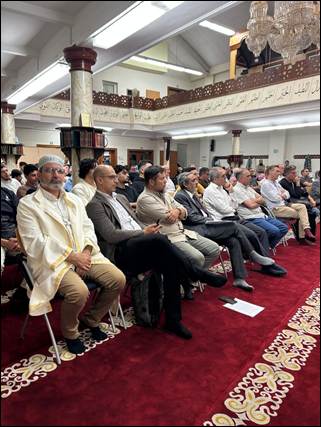
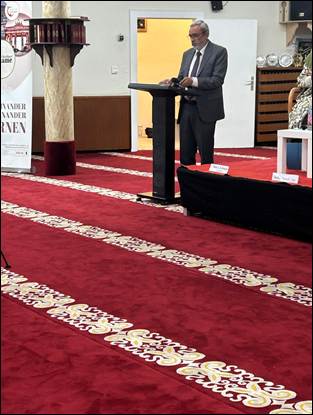
Yesterday [28 August 2026], the Council of Imams of Berlin held an important meeting with political representatives in connection with the upcoming Berlin elections. The meeting was organized by the Dar Assalam mosque in Berlin. The meeting provided a valuable opportunity for open and constructive dialogue on issues concerning democracy, social cohesion, peaceful coexistence, and the role of religious communities in our diverse society.
The participants emphasized the importance of mutual respect, dialogue, and the active participation of all citizens in shaping the future of Berlin. Dialogue builds bridges and strengthens our democracy. I delivered the concluding remarks.
Photographs of the occasion, showing our Imam in the audience, and speaking
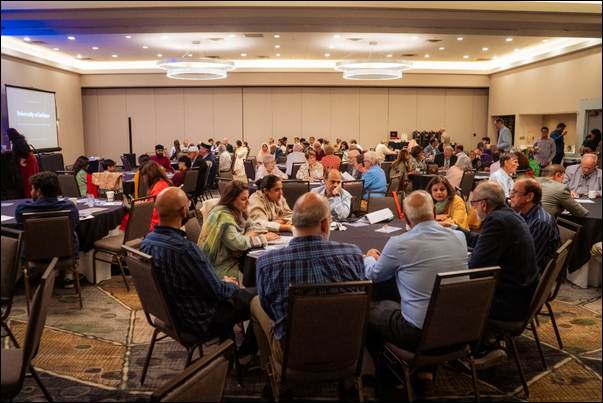
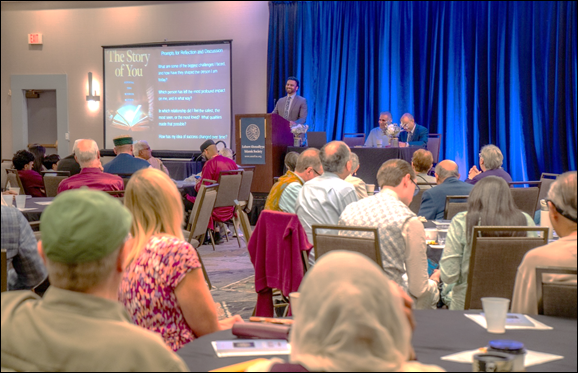
The 2026 Annual Convention of the Lahore Ahmadiyya Islamic Society (USA) was held in Dublin, Ohio, USA, from Friday July 24 to Sunday July 26. We publish here some photos from this international event.

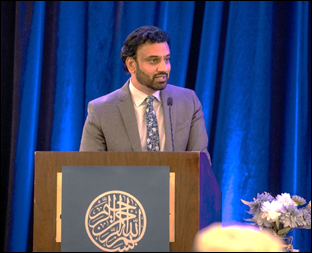
Fazeel
S. Khan
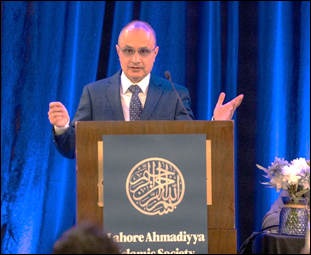
Tariq Ahmad
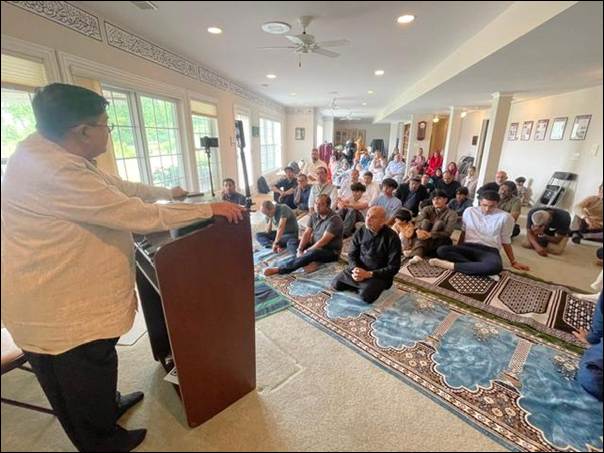
Maulana M.K. Hydal, delivering Friday Khutba
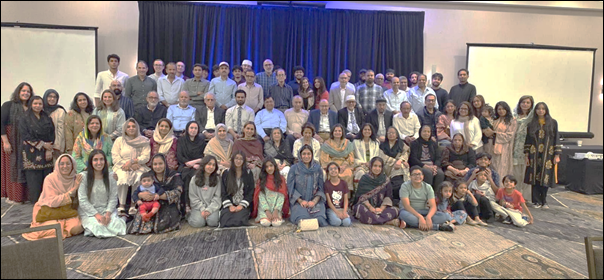
Group photo of participants from various Jamaats
A video recording of the public symposium is available at this link:
www.youtube.com/live/x4HuUFQn6HE
E-mail: islamic-view@ahmadiyya.org
For books on Islam and the Ahmadiyya Movement, please visit our websites:
(in Indonesian)
Read a selection of Lahore Ahmadiyya literature on the website archive.org at the link: http://bit.ly/4ok2NTj
Footnotes to the article Unknown dates of birth
[1] Izala Auham, p. 635; Nishan Asmani, p. 4; Barahin Ahmadiyya, Part 5, p. 97.
[2] Zamima Tuhfah Golarwiya, pp. 19–20, published 1900.
[3] Kitab-ul-Bariyya, see Ruhani Khaza’in, vol. 13, p. 177, footnote.
[4] Al-Wasiyya, pp. 1–2.
[5] The Review of Religions, Urdu edition, December 1905, p. 480; see also the Ahmadiyya community newspaper Badr, 20 October 1905, p. 3.
[6] Barahin Ahmadiyya, Part 5, p. 193.