© Ahmadiyya Anjuman Lahore Foundation (UK)
In the Name of Allah, the Beneficent, the Merciful
The Islamic View
Patron: Mr Nasir Ahmad · Editor: Dr Zahid Aziz

Worldwide Lahore Ahmadiyya Movement
A Magazine of the Central Ahmadiyya Anjuman, Lahore
Available online at: sites.google.com/jamaat.uk/theislamicview
June 2026 Vol. 2, No. 6
Contents
Present-day relevance of the issue of the death, and no return, of Jesus
Friday khutba at Darus Salaam, London, 1 May 2026, by Dr Zahid Aziz
Modern psychology research shows acts of kindness are good for mind and body
Friday khutba for Lahore Ahmadiyya UK Jama‘at, 24 April 2026, by Dr Jawad Ahmad
Hazrat Mirza Ghulam Ahmad followed the fundamentals of Islam as accepted by all
at UK Lahore Ahmadiyya Centre, London, 27 May 2026
by Ken Mustaq Ali
Photos from our Eid-ul-Adha gathering
Darus Salaam, Wembey, London, 27 May 2026
Eid-ul-Adha at our Berlin Mosque (Germany)
Present-day relevance of the issue of the death, and no return, of Jesus
Friday khutba at Darus Salaam, London, 1 May 2026,
by Dr Zahid Aziz
مَا الۡمَسِیۡحُ ابۡنُ مَرۡیَمَ
اِلَّا رَسُوۡلٌ ۚ قَدۡ خَلَتۡ مِنۡ قَبۡلِہِ الرُّسُلُ ؕ وَ اُمُّہٗ صِدِّیۡقَۃٌ
ؕ کَانَا یَاۡکُلٰنِ الطَّعَامَ ؕ
اُنۡظُرۡ کَیۡفَ نُبَیِّنُ لَہُمُ
الۡاٰیٰتِ ثُمَّ انۡظُرۡ اَنّٰی یُؤۡفَکُوۡنَ ﴿۷۵﴾
“The
Messiah, son of Mary, was only a messenger — messengers had indeed passed away
before him. And his mother was a truthful woman. They both used to eat food.
See how We make the messages clear to them, then see how they are turned away
(from truth)!” — The Quran, ch. 5, Al-Mā’idah, v. 75
وَ مَا مُحَمَّدٌ اِلَّا رَسُوۡلٌ ۚ قَدۡ خَلَتۡ مِنۡ قَبۡلِہِ الرُّسُلُ ؕ اَفَا۠ئِنۡ مَّاتَ اَوۡ قُتِلَ انۡقَلَبۡتُمۡ عَلٰۤی اَعۡقَابِکُمۡ ؕ وَ مَنۡ یَّنۡقَلِبۡ عَلٰی عَقِبَیۡہِ فَلَنۡ یَّضُرَّ اللّٰہَ شَیۡئًا ؕ وَ سَیَجۡزِی اللّٰہُ الشّٰکِرِیۡنَ ﴿۱۴۴﴾
“And Muhammad is but a messenger — messengers have already passed away before him. If then he dies or is killed, will you turn back upon your heels? And he who turns back upon his heels will do no harm at all to Allah. And Allah will reward the grateful.” — ch. 3, Āl-i ‘Imrān, v. 144
The two verses I have recited are from among the several places in the Holy Quran which prove that Jesus — ‘Īsā, peace be upon him — had died at the end of his natural lifetime. The first verse clearly states that Jesus was one of the messengers of God and that messengers who had appeared before him had passed away from this world. The implication is that Jesus also passed away like them. This is reinforced by the words about Jesus and his mother that “they both used to eat food”. It is obvious and it does not need to be said about any humans that they used to eat food during their lives. The reason for saying it here is that, as no one can deny that Jesus used to eat food and he no longer eats food, he must therefore be dead. The second verse I recited further reinforces the conclusion that Jesus was already dead by the time the Holy Prophet Muhammad appeared in the world. It says the same about the Holy Prophet as the first verse said about Jesus: that he was only a messenger, and messengers have passed away before him. It then mentions death specifically by adding: “If then he dies or is killed…” This shows that the only way messengers pass away is by death, and just as this happened in the case of the messengers before the Holy Prophet, the same is bound to happen in his case.
When both these verses say in identical words, “messengers have passed away before him”, qad khalat min qabli-hi-rusul in Arabic, the meaning is obviously that all messengers before them, without exception, passed away. If there was even one messenger before the Holy Prophet Muhammad who had not passed away, the Quran could not say that the Holy Prophet must necessarily die because he is only a messenger. People would respond that such and such a messenger has not died before him, so the Holy Prophet’s death is not a certainty.
Although the Holy Quran is absolutely clear that Jesus had died, yet when Christians in large numbers became Muslims several centuries ago they brought with them the belief that Jesus was still alive in heaven and would return to this world in person. It became a widespread belief among Muslims also. The difference was that Christians held that Jesus died on the cross, but as he was not a mortal human being, after his dead body was removed from the cross he rose to life again on the third day after his death, and then ascended into heaven to sit on the right hand side of God. Muslims believed that he rose up to heaven without dying at all. But both Christians and Muslims believed that he would return to this world. Each believed that after his return he would establish a kingdom for them and rule over them.
Now, for centuries this belief didn’t matter much in practice; it was just like a story which doesn’t affect people’s lives. Then came the modern times, starting in the 1800s, when Christian missionaries spread all over the world, including most places where Muslims lived, and began to convert people to Christianity. In their preaching to Muslims, they found this belief of the Muslims to be a highly useful tool. They said to Muslims: You yourself believe that Jesus is alive with Allah in heaven and will return to this world, while your Prophet Muhammad died like a mortal human. This means Jesus is in an entirely higher and superior category to your Prophet, who will never return. By using this argument, they not only attracted many Muslims into Christianity but also put a much larger number of Muslims to embarrassment and shame about their own religion of Islam. Muslims were rendered speechless in facing Christian preachers.
It was at this time in the Indian subcontinent that the Founder of the Ahmadiyya Movement, Hazrat Mirza Ghulam Ahmad, arose as a God-sent defender of Islam. Allah illuminated his mind to the fact that according to the Quran Jesus had died, as for example, clearly indicated in the two verses that I recited at the beginning. That same Jesus in person can never return to this world. After Hazrat Mirza sahib wrote books presenting this view in detail, with evidence, those Muslims who accepted him were able to repel and repulse the arguments about Jesus that were being used by Christian preachers to defeat the Muslims. As a result of Hazrat Mirza Ghulam Ahmad proving from the Quran that Jesus was not alive in heaven, waiting to return to earth, many Muslims were saved from leaving Islam to become Christians.
Today, of course, even the many Muslims who believe that Jesus is still alive and will return are no longer under any pressure on this belief from Christian preachers. Recently, someone said to me that this means that the work of Hazrat Mirza Ghulam Ahmad is no longer relevant for Muslims, because they are no longer facing any threat or embarrassment on the basis of holding this belief. This person said that correcting the wrong belief about Jesus held by Muslims served a purpose a hundred years ago but it no longer serves any purpose because the issue has lost its importance.
I replied that belief in the return of Jesus is the biggest threat to world peace today and has brought the world to the brink of destruction at this very moment. I will now explain how. The biggest threat to world peace today is the conflicts in the Middle East, centred on Israel and Jerusalem. There are three religions involved in these conflicts: the Jewish, the Christian, and the Muslim religions. The followers of each of the three religions are awaiting the coming of a Messiah to establish his kingdom and lead them to victory. The Jews have long expected a Messiah to come, since long before the time of Jesus. When Jesus appeared among them, they rejected his claim to be the Messiah because he possessed no kingdom or rule, nor did he liberate them militarily and give them their own state. They are still expecting that Messiah to come, and many of them regard the founding of the state of Israel as a preliminary to his coming.
Christians, of course, accept Jesus as the Messiah, but believe that he is alive in heaven and will return and establish his rule with Jerusalem as his capital. The so-called evangelical Christians in the USA, who fervently support the state of Israel, believe that the founding of this state was a preparation by God for the second coming of Jesus, so that with Jews gathered in one place he may convert them to Christianity. This situation is very strange but it is true that the most staunch supporters of the state of Israel in the USA support it because they believe that this will facilitate Jesus to convert all the Jews there to Christianity. Their view is that the Jews rejected Jesus when he first appeared 2000 years ago, but are now destined to accept him as their head and king. The third group is, of course, the Muslims. The vast majority of them are also looking forward to the return of Jesus, the prophet ‘Īsā, and they believe that he will wage war to make Islam triumphant in the world, especially over the Jews and the Christians, and that he will even force people to convert to Islam.
There are, therefore, three religions in the world today whose followers, in general, believe that the same Messiah will come in the world, arriving in the centre of that region in the Middle East, and the followers of each of the three groups believe that he will convert the other groups to their faith, make their faith the ruling one, and very little will be left of the other two groups. Hazrat Mirza Ghulam Ahmad came to declare to the world that no such Messiah will come in the way that the various people are expecting. He did not reject the prophecies that a Messiah will come, but said that people had misinterpreted those prophecies to satisfy their own material and worldly desires, that a Messiah will come and give them worldly power, rule and wealth over everyone else. He explained that the title ‘Messiah’ indicates that he will breathe spiritual life into spiritually-dead people, and that he will be a humble preacher, just like Jesus was, possessing no worldly power or position, nor seeking it. He claimed to be that Messiah who would breathe spiritual life into Muslims and would preach Islam only by persuasive arguments and presenting signs of its truth.
So the issue of the death of Jesus is as relevant today as it was in the time of the Founder of the Ahmadiyya Movement; perhaps even more relevant now. It is not merely a point of historical interest because it is connected with the belief that Jesus will come into this world again. If the Christian evangelicals of the USA could be persuaded that Jesus died, once and for all times, then they will have to abandon their belief that Israel was established by God Himself in preparation for welcoming Jesus back to earth so that he can convert all Jews to Christianity.
If the general body of Muslims accepted that Jesus has died, then they will have to abandon their belief that he will return and force everyone to embrace Islam. Such a belief and expectation brings Islam into disrepute because it means that Islam will be spread by force. If Muslims in general give up this belief in the way suggested by the Founder of the Ahmadiyya Movement, they will realise that Islam will not be successful by any political or military means, but it will only succeed if Muslims awaken to a spiritual and moral life within themselves and present Islam to the world by reasoning and logical evidence, in a peaceful manner, and show by their own example of how a true Muslim behaves.
Let us pray that Allah enables followers of all religions, Muslims and non-Muslims, to give up these wrong ideas that their religion will win by God sending someone to establish its rule and power over all others, and that God favours them and is on their side regardless of their actions. Ameen.
Note: The audio form of this khutba is available at the following link.
www.youtube.com/watch?v=SYPYU913Hjk
In Pakistan, Ahmadis are prohibited by law to offer the Eid-ul-Adha sacrifice or hold Eid-ul-Adha prayers. The Quran says:
“And who is more unjust than he who prevents (people) from the mosques of Allah, from His name being remembered in them, and strives to ruin them?” (2:114)
Modern psychology research shows acts of kindness are good for mind and body
Friday khutba for Lahore
Ahmadiyya UK Jama‘at, 24 April 2026,
by Dr Jawad Ahmad
اَرَءَیۡتَ الَّذِیۡ یُکَذِّبُ بِالدِّیۡنِ ؕ﴿۱﴾ فَذٰلِکَ الَّذِیۡ یَدُعُّ الۡیَتِیۡمَ ۙ﴿۲﴾ وَ لَا یَحُضُّ عَلٰی طَعَامِ الۡمِسۡکِیۡنِ ؕ﴿۳﴾ فَوَیۡلٌ لِّلۡمُصَلِّیۡنَ ۙ﴿۴﴾ الَّذِیۡنَ ہُمۡ عَنۡ صَلَاتِہِمۡ سَاہُوۡنَ ۙ﴿۵﴾الَّذِیۡنَ ہُمۡ یُرَآءُوۡنَ ۙ﴿۶﴾ وَ یَمۡنَعُوۡنَ الۡمَاعُوۡنَ ٪﴿۷﴾
— The Holy Quran, ch. 107, Al-Mā‘ūn
I would like to draw your attention to a small chapter of the Holy Quran which urges us not to ignore doing small acts of kindness. It very candidly tells us how doing small acts of kindness generates feelings of mutual concern and sympathy:
“Have you seen him who belies religion? That is the one who is rough to the orphan, and urges not the feeding of the needy. So woe to the praying ones, who are unmindful of their prayer; who do (good) to be seen, and refrain from acts of kindness!” — The Holy Quran, ch. 107, Al-Mā‘ūn
Doing acts of kindness means to be helpful. There are two different behaviours. Firstly, somebody may ask you for help or maybe you offer to help him without his asking for it. Secondly, when you do not like a person for any wrong done by him to you, and either you desist from helping him or you ask others to desist from helping him. The concept of doing good in Islam is over and above these considerations. It is a duty imposed by Allah irrespective of whether you like it or not. Such an act is for the love of Allah. This is the sort of kindness which Allah wants us to develop in our attitude and behaviour.
Salah [prayer], fasting, and other rituals are prescribed as exercises to develop such a selflessness and outright love and sympathy for fellow beings. The kindness shown in obedience and love of God is called loving-kindness. It is through worship and complete submission to our Creator and Nourisher that we are blessed with spontaneous love for human beings. It is this loving-kindness for which we seek guidance from God in our daily prayers:
“It is You alone Whom we worship and it is You alone from Whom we seek help. Guide us on the right path” (1:4-5).
That is, help to keep us on the right path, the path of loving-kindness. In this opening chapter of the Quran, Al-Fatihah, the words Rabb-ul-‘ālamīn announce that God has enjoined this guidance for all human beings and has thus broadened a Muslim’s vision and behaviour towards his fellow beings. This love and kindness starts from one’s parents and extends to family members, near and far relatives, neighbours, the needy, companions on a journey, and so on and so forth, as the Holy Quran says:
“And do good to (your) parents, and to the near of kin and to orphans and the needy, and speak good (words) to (all) people, and keep up prayer and pay the poor-rate” (2:83).
The Quran also shows concern for a section of people who deserve but do not ask for it. It says that charity is also for:
“The poor who are confined in the way of Allah, they cannot go about in the land; the ignorant man thinks them to be rich on account of (their) abstaining (from begging)” (2:273).
Selflessness transcends all sorts of material considerations and connects us to one another at the highest level of humanity. This level is called in the Quran “Love of God”. It was to establish this love of God for which the Holy Prophet was raised. In the Holy Quran Allah asks the Holy Prophet to convey the message that:
“If you love Allah, follow me: Allah will love you” (3:31).
The Quran also tells us how to attract the love of God:
“And do good (to others). Surely Allah loves the doers of good” (2:195).
Thus an act of kindness brings forth three positive effects:
1. On your own self — a feeling of satisfaction by imparting love to one in need out of what Allah has blessed you.
2. The beneficiary develops a sense of gratitude.
3. But perhaps the most positive of all will be on a passer-by who just happens to witness the act. This becomes a source of inspiration for others.
We all know that there is always, somewhere, a person who stands in need, and there is an opportunity for kindness to make a difference. And this is what humanity is all about. A social thinker has beautifully explained how an act of kindness tends to initiate a humble start of bringing change:
“When we treat people merely as they are, they will remain as they are. But when we treat them as if they were what they should be, they will become what they should be” (Thomas S. Monson, 1927).
Let me quote here some sayings on how kindness educates us, develops noble qualities in us, and enables us to contribute something positive to our own selves and to the society as a whole:
“Your greatness is measured by your kindness; your education and intellect by your modesty; your ignorance is betrayed by your suspicions and prejudices, and your real calibre is measured by the consideration and tolerance you have for others.”
“Kindness is indeed the backbone of love.”
“When you blame others, you give up your power to change.”
The Holy Quran has drawn our attention in a simple but positive way to how good deeds improve one in making him a responsible person, contributing goodness to the society. This is what we call an attitude of social service — change for the better. Call it a healthy society. Call it a welfare society. Call it a progressive society. But such a society must give the highest regard to truth, good deeds, and human welfare. The Holy Quran gives us a guideline:
“Surely good deeds take away evil deeds” (11:114).
This is what Islam wants to teach us and this is what religious beliefs and acts intend to bring about — change in the mind and heart of a human being. In the words of the Quran this process is called hasanah or good. And this is what Allah has asked us to always seek:
“Rabbanaa aa–ti-naa fid-dun-yaa hasanah, wa fil aa-khi-ra-ti hasanah. — Our Lord, grant us good in this world and good in the Hereafter” (2:201).
For Muslims, hasanah or good means reward. There is another word, thawaab, which has been used in the Quran. However, to get reward, the Quran tells us to do good deeds:
“Allah’s reward is better for him who believes and does good” (28:80).
How Allah rewards human beings for virtuous deeds is a vast subject. For now, I will briefly tell you how kindness or charitable acts bring about a wholesome change in our thoughts and actions. Glancing through Google I found one such research study which tells us:
“Would you like to feel better and change your negative feelings into positive ones? All you need to do is to be kind to your fellow human beings. Experience has proved that kindness acts as a natural anti-depressant. Being kind is a scientifically proven way to improve your spirits.”
In his bestselling book, The Power of Intention, Dr Wayne W. Dyer sites research that shows that an act of kindness increases the serotonin levels in your brain. Serotonin is a natural chemical in your body that is responsible for improving your mood. Many of the anti-depressant medications on the market today work by enhancing the body’s utilization of serotonin. According to Dr Dyer, however, science has discovered that an act of kindness will increase the release of serotonin in your brain without the need for medication. The interesting conclusions found are that serotonin levels are increased in both the giver and the receiver of an act of kindness. In addition, anyone who witnesses an act of kindness also has an increase in serotonin levels. Thus kindness is a natural anti-depressant for the giver, the receiver, and the witness of human compassion. Dr Dyer writes:
“A recent example in my own life illustrates the truth of the above findings. Days before this last Christmas, my bookkeeper came to my office to help with yearend accounting. Normally, she works in a focused manner, but on this particular day she was preoccupied. She told me of a young boy who wrote to Santa Claus asking only for a new bed. His bed was worn, with holes in it, and all he wanted for Christmas was a new bed. No toys, just a bed. Too distracted to work on my accounting, my bookkeeper picked up the phone and began calling furniture shops with the intention one would be willing to gift a bed for this child. Kindly, one furniture store did. Just to be a witness to this episode brought tears to my eyes, enormous respect for my bookkeeper, and gratitude that Santa would bring a bed to this boy.”
Barbara Fredrickson, professor of psychology at the University of North Carolina, Chapel Hill, says:
“We’ve had a lot of indirect clues that relationships are healing. What’s exciting about this study is that it suggests that every [positive] interaction we have with people is a miniature health tune-up.”
For instance, being a good friend, and being compassionate toward others, may be one of the best ways to improve your own health.
The Holy Quran repeatedly urges believers to be maintainers of justice, doers of kindness and charitable acts, and to be gentle and forgiving in behaviour, for these are the people who earn the love and blessings of God:
“Surely Allah enjoins justice and the doing of good (to others) and the giving to the kindred … He instructs you that you may be mindful” (16:90).
“Those who spend in ease as well as in adversity and those who restrain (their) anger and pardon men. And Allah loves the doers of good (to others). … Their reward is protection from their Lord, and Gardens wherein flow rivers, to abide in them. And excellent is the reward of the doers of good” (3:134, 136).
It will not be wrong to conclude:
1. That being kind is more important than being right.
2. That I can always pray for someone when I don't have the strength to help him in some other way.
3. That sometimes all a person needs is a hand to hold, and a heart to understand.
4. That it's those small daily happenings that make life so spectacular.
5. That one should keep his words both soft and tender because tomorrow he may have to eat them.
Some more phrases and proverbs:
“The basis of wisdom, after faith in Allah, is loving-kindness toward people.”
“He who is deprived of kindness is deprived of goodness.”
“You must be gentle. Verily, gentleness is not in anything except that it beautifies it, and it is not removed from anything except that it disgraces it.”
The Quran is the final testament which is a true compendium of the pristine teachings of the past. All prophets, sages, and religious scholars of all religions have regarded kindness and humility as key to moral perfection. Let us see what the Bible says:
“Love is patient, love is kind. It does not envy, it does not boast, it is not proud. It does not dishonour others, it is not self-seeking, it is not easily angered, it keeps no record of wrongs. Love does not delight in evil but rejoices with the truth. It always protects, always trusts, always hopes, always perseveres” (1 Corinthians, 13:4-7).
“Your beauty should not come from outward adornment, such as elaborate hairstyles and the wearing of gold jewellery or fine clothes. Rather, it should be that of your inner self, the unfading beauty of a gentle and quiet spirit, which is of great worth in God’s sight” (1 Peter, 3:3-4).
“What good is it, my brothers and sisters, if someone claims to have faith but has no deeds? Can such faith save them? … But someone will say, ‘You have faith; I have deeds.’ Show me your faith without deeds, and I will show you my faith by my deeds” (James, 2:14, 18).
Allah sent innumerable prophets and saints and reformers to show love and to teach love and to demonstrate love so that Allah may show His bounties of grace. One of these was the Imam of this age, Hazrat Mirza Ghulam Ahmad, the Great Reformer of the Muslims, and it is due to him that we are all together and praising out loud and benefitting from the true teachings of Islam.
Rabb-ba-naa ta-qabb-bal minn-naa, inn-naka an-tas sa-mee-‘ul ‘a-leem. Our Lord, accept our prayers. You are Gracious in granting audience to Your servants and also accepting their petitions. Ameen.
Hazrat Mirza Ghulam Ahmad followed the fundamentals of Islam as accepted by all
Hazrat Mirza Ghulam Ahmad wrote and stated repeatedly that it is a false allegation against him that he and his followers have deviated from the fundamental beliefs and practices of Islam that have been recognised as its pillars throughout its history. In his Arabic book Mawāhib-ur-Raḥmān, published in 1903, he wrote:
“No one enters our Jama‘at except one who has entered the religion of Islam and follows the Book of Allah and the Sunna of our Leader, the best of mankind [the Holy Prophet Muhammad], and believes in Allah and His honourable Messenger, and in the Day of Resurrection, and Heaven and Hell. And he resolves and affirms that he will not seek a religion other than Islam, and shall die holding this faith, which is the religion of nature. He will hold fast to the Book of Allah and will act upon everything established from the Sunna and the Quran and the consensus of the honoured Companions [of the Holy Prophet]. Whoever abandons these three sources abandons his soul to the fire of hell” (Ruhānī Khazā’in, vol. 19, p. 315).
Thus, everyone who accepts and follows Hazrat Mirza Ghulam Ahmad must first of all be a Muslim.
In his earlier book, Izāla Auhām, published in 1891, shortly after he claimed to be the Promised Messiah and faced the wrath of the Muslim religious leaders, he wrote:
“Their misconception is quite absurd that, in accepting my claim, a person risks damage to his faith. I fail to understand what could cause that damage. There would have been damage if this humble one had compelled his followers to follow new teachings, opposed to the teaching of Islam. For example, if I had declared a lawful thing to be forbidden or vice-versa, or had introduced any changes in those tenets of the religion which are essential for salvation, or I had introduced any increase or decrease in matters of fasting, prayer, pilgrimage, and zakat, etc., which are duties prescribed by the Shari‘ah. For instance, if I had prescribed prayers ten times a day in place of the five, or just two, or prescribed two months of fasting in place of one month, or fasting for less than a month, then there would have been nothing but spiritual loss; in fact, disbelief and destruction. But given that this humble one repeatedly says only this, O brothers, I have not brought any new religion nor any new teaching, but I am one of you, and a Muslim like you, and for us Muslims there is no other book to follow except the Holy Quran, nor is there any other revealed book to which we invite others to follow, and when I affirm that except for the Khātam-ul-Mursalīn, Ahmad of Arabia, on whom be peace and the blessings of Allah, there is none to guide us and none to be followed by us, and none whom we would like others to follow, then where lies the risk for a religious Muslim to believe in my claim which is based on revelation from Allah?” (Ruhānī Khazā’in, vol. 3, pp. 187–188).
The following year, 1892, he wrote in his voluminous book Ā’īnah Kamālāt Islām (A Mirror of the Perfections of Islam):
“Prophets come with the purpose of changing the religion, changing the qibla [direction in which people pray], cancelling some of the [existing] commandments, and introducing some new commandments. But in my case there is no claim of such a revolution. There is the same Islam as before, the same prayers as before, the same Chosen Prophet as before, and the same Holy Book as before. One does not have to omit any such thing from the original faith as to cause so much perplexity. The claim to be the Promised Messiah would have been dangerous, and worthy of being treated with caution, if, along with this claim, there was some alteration — God forbid — in the commandments of the faith, so that our practices would have been somewhat different from those of other Muslims. …
If the claim of being the Promised Messiah had any requisites which adversely affected the commandments and beliefs of the Shari‘ah, that indeed would have been terrible. What should be considered is: what Islamic truth have I transformed by my claim, and which are the commandments of Islam in which I have made an increase or decrease of even an iota? True, I have interpreted a prophecy according to the meanings disclosed to me by God the Most High in this age; the Holy Quran provides evidence to prove the truth of these meanings, as do the authentic sayings of the Holy Prophet. Why is there then so much hue and cry?” (Ruhānī Khazā’in, vol. 5, pp. 339–340).
In his speech at the last annual gathering of the Jama‘at during his life, in December 1907, he said:
“Efforts were made in every way to destroy and obliterate me. Different kinds of denunciations were prepared against us declaring us as kāfir and worse in disbelief than even the Christians and the Jews. This was despite the fact that we believe in the holy Kalima, ‘There is no god except Allah and Muhammad is the Messenger of Allah,’ with our heart and soul. We consider the Holy Quran as God’s true and perfect Book, and accept it with all sincerity of heart to be the last of the Books, and with all sincerity of heart we believe the Holy Prophet, on whom be peace and the blessings of Allah, to be Khātam-un-Nabiyyīn [Seal of the Prophets]. Our prayers are the same, we face the same Qibla, fast in the month of Ramadan in the same manner, and there is no difference in our hajj and zakat. Therefore, it is unknown for what reasons we were declared worse than even the Jews and the Christians, and abusing us day and night was considered to bring heavenly reward. After all, there is some such thing as decency. Such methods are only adopted by people whose faith has been lost and whose hearts have darkened” (Malfūzāt, vol. 10, pp. 48–49).
at UK Lahore Ahmadiyya Centre, London, 27 May 2026
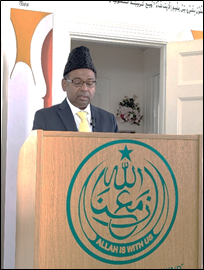
Today we join with the pilgrims in Makkah and celebrate Eid-ul-Adha, also known as the Greater Eid. We commemorate the sacrifices made by Abraham, Ishmael, and Hagar, a family who endured trials and difficulties so that we should understand that if we had to go through trials and difficulties we will not be the first and certainly not the last. These are the pre-requisites to leadership. In relation to trials in our lives, Allah says in the Quran: “Do you think that you would say that you believe and not be tried” (29:2).
My khutba today adopts a slightly different approach to the traditional discussion of what we are all accustomed to. We are all familiar with the life of Abraham, Ishmael, Hagar, and the significance of hajj. I wanted to have a twist to this Eid, as we are seeing and living in a different time in the history of mankind. We have difficult times ahead, some of the most difficult that we will ever see in human history.
The verse that I have chosen for today’s khutba is translated as follows: “If you love Allah, follow me (i.e., the Holy Prophet Muhammad): Allah will love you, and grant you protection from your sins. And Allah is Forgiving, Merciful” (3:31). Looking at the translation, it does not appear to have anything to do with sacrifice, but let us look a little closer.
If I were to ask you why did Allah create you, would you be able to answer with confidence? Would your answer be based on science, philosophy, or from verses of the Quran? I am not asking you to become a philosopher or an Islamic scholar. I am asking you to think about your relationship with the Creator and Maintainer of the universe and to think deeply about why you were created. Did anyone of us have a choice in our being created? Abraham gave much thought to his relationship with Allah and with his people — this narrative is found in the Quran in chapter 6, verses 75–79. He questioned the rising and setting of the stars, the sun, and the moon, and eventually concluded by saying: “Surely I have turned myself, being upright, wholly to Him Who originated the heavens and the earth, and I am not of those who set up partners (with Allah)” (6:79). He used his power of observation and reasoning and these gave him the conviction to dispute with his people who had made and worshiped idols.
Chapter 6, verse 80 states: “And his people disputed with him. He said: Do you dispute with me respecting Allah and He has guided me indeed? And I do not fear in any way those that you set up with Him, unless my Lord please. My Lord comprehends all things in His knowledge. Will you not then be mindful?”
So, in this example of Abraham we need to reflect on the creation of the universe and make conclusions for ourselves and develop convictions to strengthen our faith. This would give us steadfastness to keep on doing the right things in spite of the onslaught that our faith will come under — not to mention our Jama‘at and our beliefs. A huge part of Abraham’s sacrifice was inward reflection, observing nature and working out what was created and distinguishing that from the Creator.
Our creation was not by chance
Coming back to the question of why we were created, I would like to quote an astrophysicist who is a self-declared atheist: Neil deGrasse Tyson. An interviewer put to him:
“And you state this, the total number of people who have ever been born is about 100 billion. Yet the genetic code that generates viable versions of us is capable of at least 10 to the 30 variations. That astronomically huge number is a one followed by 30 zeros providing a million trillion trillion possible souls. So far, our branch of the tree of life has produced no more than 0.0000000000000001% at 16 zeros of all possible humans forcing the conclusion that most people who could ever exist will never even be conceived. So that means that each of us, for all practical purposes, is unique in the universe now and forever. It’s one of the most magical thoughts I think I’ve ever been encountered” (Design Matters: Neil deGrasse Tyson, interview by Debbie Millman, April 2023. See this link.)
Dr Tyson responded:
“And it also means you’re the lucky one to even be alive. … Most people who could exist will never exist. And so for that reason, I think to myself, you won the lottery. And why not use this occasion to make the world better today than it was yesterday? And to bring joy to the world. Life is precious. The very fact of being alive.”
From his statements we conclude that our creation is not by mere chance but a special design and that we have been handpicked by Allah to be born and to be here. We were created by Allah out of His love for us. This is the sacrifice that our Lord made for us. Once we are born, we can never truly die; we move through this life into the next and then live forever. We have been chosen to experience a journey through time. And we have been told in the Quran (ch. 103) that by the passing of time, mankind becomes lost, except those who exhort one another to Truth, and exhort one another to patience. What sacrifice have you made to deserve this special privilege? Please think about this deeply and decide how you want to say thanks for the opportunity to live forever.
Allah says in the Quran: “He it is Who shapes you in the wombs as He pleases. There is no god but He, the Mighty, the Wise” (3:6). He created every one of us with a unique fingerprint and retina. Our creation is not without purpose. We all have the potential to imbue ourselves with Allah’s attributes. This is how Allah lives through us, this is how some of His attributes become manifest to us.
We are set up for success through the examples of Abraham and his family and of the Holy Prophet Muhammad. Allah says in the Quran: “Certainly you have in the Messenger of Allah an excellent exemplar for him who hopes in Allah and the Last Day, and remembers Allah much” (33:21).
The examples of all prophets as an extension of the love of Allah
All of the prophets had difficulties and trials, and they never had the comforts and luxuries that we have today. A close study of the Quran and the Bible shows a historical pattern. The Quran reminds us that those before us were tested. Certainly, we know of the tests, for example, of Adam having to learn that one of his sons killed the other, of Noah being rejected by his people and watching his son drown, Moses fleeing from the Pharaoh, Job being riddled with illness. We also read of Mary, despite her devotion to God, being accused by way of a calumny by the Jews; Asiyah, the wife of Pharaoh, praying to be delivered from his wrongdoing. Later on, Jesus being nailed on a cross and humiliated by the people that he was sent to reform; Joseph thrown into a well by his brothers; Abraham rejected by his people, childless till old age, then being asked to leave his only child at that time and his wife in the wilderness; and the Holy Prophet Muhammad stoned in Taif, boycotted, and politically isolated by his own tribe and attempts made on his life.
These were not just problems which they all faced; these were challenges they all had to overcome in order to achieve something greater.
Some trials that the Holy Prophet Muhammad and his followers faced were so difficult that the Quran says: “Or do you think that you will enter the Garden, while there has not yet befallen you the like of what befell those who have passed away before you? Distress and affliction befell them and they were shaken violently, so that the Messenger and those who believed with him said: When will the help of Allah come? Now surely the help of Allah is near!” (2:214). There is a divine reason for all of this and that is for us to rely solely on Allah so that He becomes our Friend just as Abraham was called the Friend of Allah.
Chapter 4, verse 125 states: “And who is better in religion than he who submits himself entirely to Allah while doing good (to others) and follows the faith of Abraham, the upright one? And Allah took Abraham for a friend.”
These are the parameters which Allah requires for His friendship; that is, submission of oneself entirely to Allah and the doing good to others, both of which work hand in hand and not in isolation.
The Hajj in Makkah
In spite of the challenging times in which we are living, especially our brothers and sisters and children in the Middle East, we are joining the pilgrims in Makkah in remembering the trials of the family of Abraham who had to overcome much more than we may ever see in our own lives. The significance of all of the trials faced by Abraham and his family must not be taken lightly because there is a promise of Allah to His friend Abraham for overcoming all of these difficulties without failure. During the periods of sacrifice Abraham never failed in the observance of his duty to Allah. Thus the Quran says that for this consistency in difficulty, Abraham’s reward is the salutation: “And We granted him among the later generations (the salutation), Peace be on Abraham!” (37:108–109).
So more than one billion people, five times a day recite in every prayer the Darood Sharif: “O Allah! Exalt Muhammad and the true followers of Muhammad as You did exalt Abraham and the true followers of Abraham; surely You are the Praised, the Magnified. “O Allah! Bless Muhammad and the true followers of Muhammad as You did bless Abraham and the true followers of Abraham; surely You are the Praised, the Magnified.” This is a promise of Allah to Abraham and his true followers that continues till today and will continue till the end of time.
Observance of duty is greater than sacrificing an animal
We are admonished in the Quran: “Not their flesh, nor their blood, reaches Allah, but to Him is acceptable observance of duty on your part. Thus has He made them subservient to you, that you may magnify Allah for guiding you aright. And give good news to those who do good (to others)” (22:37). Again: “O you who believe, be upright for Allah, bearers of witness with justice; and let not hatred of a people incite you not to act equitably. Be just; that is nearer to observance of duty. And keep your duty to Allah. Surely Allah is Aware of what you do” (5:8). Yet again: “O you who believe, keep your duty to Allah, and let every soul consider that which it sends forth for the morrow, and keep your duty to Allah. Surely Allah is Aware of what you do” (59:18).
The Quran tells us what the reward is for keeping your duty: “But those who keep their duty to their Lord, for them are Gardens wherein flow rivers, to abide therein; an entertainment from Allah. And that which Allah has in store for the righteous is best” (3:198).
So, it is imperative that we do not lose sight of the spirit behind the qurbani [sacrifice]. It reminds us that observance of duty to Allah, doing good to others, and the need to completely sacrifice our animal self that threatens to devour our souls and prevent our progress is the true qurbani.
Prayer and sacrifice
However, qurbani is not complete without prayer. Therefore, Allah admonishes us in Surah Al-Kauthar: “So pray to your Lord and sacrifice” (108:2). And this should be done in the face of difficulties and the words of people that will offend you. Moreover, why should we do this? It is because our enemy is cut off from receiving these blessings on account of their rejection of qarb (nearness to Allah); instead, they choose nearness to this world and the appetite of their desires rather than nearness to Allah.
Some of the characteristics of these people are explained beautifully in the Quran in chapter 9, verse 34, which states: “O you who believe, surely many of the doctors of law and the monks eat away the property of men falsely, and hinder (them) from Allah’s way. And those who hoard up gold and silver and spend it not in Allah’s way — announce to them a painful chastisement.” Today mankind has developed sophisticated AI equipment to scan the ocean bed to find gold so that they can hoard it and prevent the average person from owning any real gold. What a fulfilment of the verses of the Quran in our lifetime! Look at the prices of gold and silver. Little that they know that it belongs to Allah! We must leave it all and return to Allah.
Two different sacrifices in the examples of Ishmael or Abel
Some say that we should be ready to lay down our lives for the sake of Allah, that this is the ultimate sacrifice. Is this a command of Allah? The example of Ishmael being a young man and prepared to do this is unheard of anywhere else. But if we look closely, we will see that this was also the example of one of the sons of Adam (Abel) when he said to his brother: “If you stretch out your hand against me to kill me, I shall not stretch out my hand against you to kill you. Surely I fear Allah, the Lord of the worlds: I would rather that you should bear the sin against me and your own sin; thus you would be of the companions of the Fire; and that is the recompense of the unjust” (5:28–29). A stark contrast is seen here. Abel died knowing what was the intention of his brother and was prepared to die rather than bear sin. Ishmael, on the other hand, offered his life for sacrifice with full conviction that the will of Allah should be fulfilled, but he lived and went on to become a great leader. The Quran says about the children of Abraham: “But indeed We have given to Abraham’s children the Book and the Wisdom, and We have given them a grand kingdom” (4:54)
In a hadith of the Holy Prophet Muhammad it is said that the ink of a scholar is holier than the blood of a martyr. Therefore, the emphasis is on educating ourselves, being one possessing knowledge like Abraham rather than losing our life in fighting. This is elucidated in the hadith which states that “one man with knowledge is harder on the devil than 1000 praying ones” (Tirmidhi, hadith 2681). It is possibly why the first command revealed in the Quran was to “read” [96:1]. Essentially, Allah was saying to the Holy Prophet Muhammad that in order to develop himself to be a leader he must educate himself, so Allah will not accept excuses. Today we all have excuses why we can’t do something.
All of the prophets made sacrifices, some with their own lives. Sacrifice builds character, trials build patience, and imbuing yourself with the colours of Allah creates within you the manifestation of the attributes of Allah. This is the true potential of the human soul, and this is why we are encouraged to “imbue ourselves with the attributes of Allah”. This is not a physical colouring, as Allah is not physical, but it is a spiritual awakening, even if it is just one attribute that we develop. This is how Allah exists in us, this is how we attain nearness to Him, this is how our salah becomes our personal miraj [elevation]. When we make sacrifices we take small steps towards Allah. It is narrated in the Hadith that if we take one step towards Allah, He takes ten steps towards us. If we approach Him walking, He comes towards us running.
As we celebrate the festival of Eid-ul-Adha, we must keep in mind its spiritual significance. It is a day to reflect upon the good example of Prophet Ibrahim, blessings of Allah be upon him and those with him, blessings of Allah be upon them all. Hazrat Ibrahim as well as Hazrat Ismail and Hazrat Hajira exemplify for us models of complete submission to the will of Allah, associating no other with Him. All the major devotional acts of hajj celebrate the high example of sacrifice and submission to the will of Allah demonstrated in their lives.
Conclusion
To summarise today’s khutba, our being born was a Divine choice, and observance of duty and doing good to others is greater than sacrificing an animal. As the Quran alludes, as long as we have life, we should pray to Allah and make sacrifice for others. If you love Allah, then follow the Messenger and Allah with love you. Is there anything greater that you need in your life than the love of Allah? What are you willing to sacrifice for it?
Photos from our Eid-ul-Adha gathering
Darus Salaam, Wembey, London, 27 May 2026
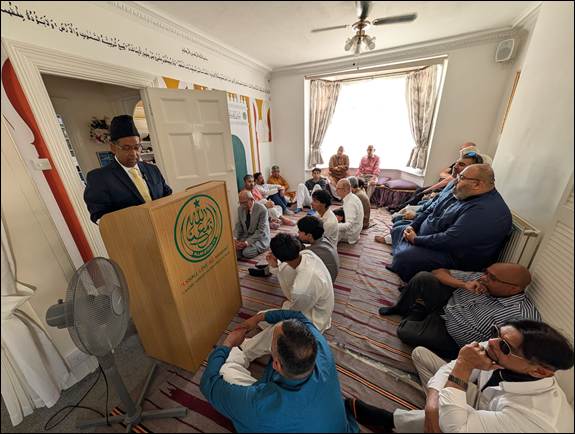
Men listening to the khutba by Ken Mustaq Ali
(For women’s section, see next page)
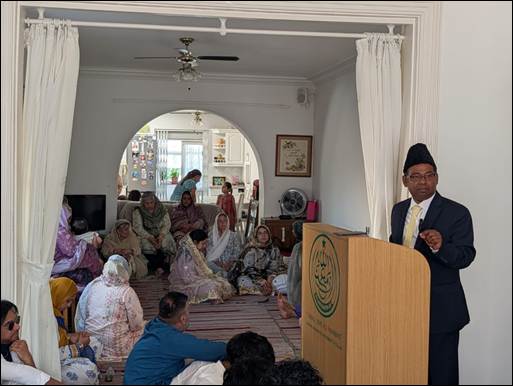
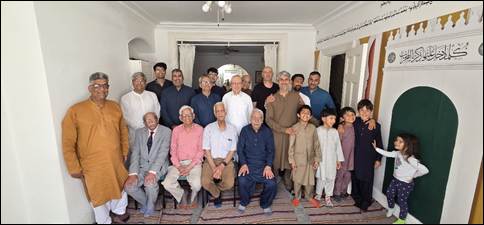
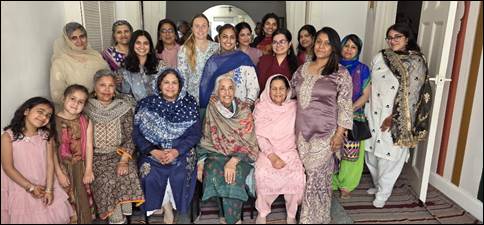
Group photos after the prayer
Eid-ul-Adha at our Berlin Mosque (Germany)
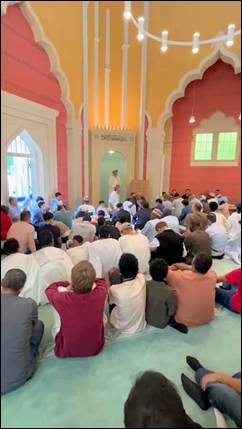
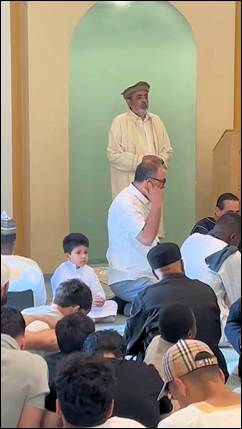
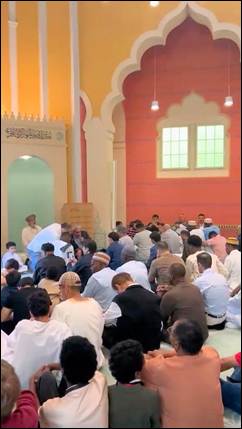
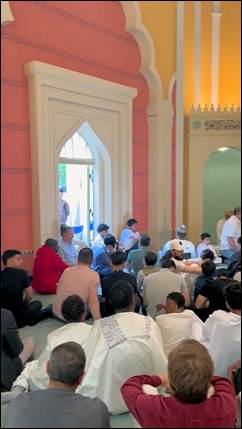
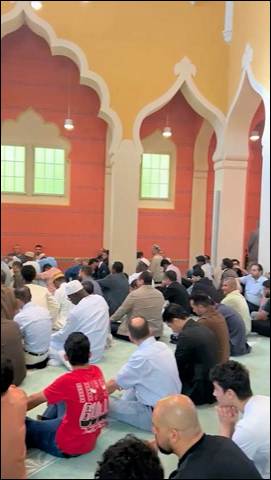
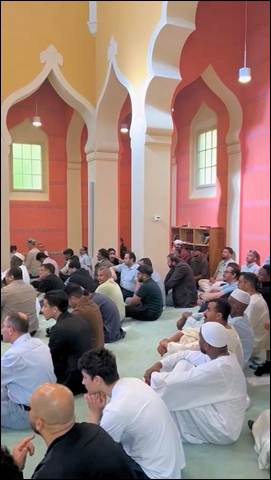
Link to watch video of this scene (at the ahmadiyya.lahore YouTube channel)
E-mail: islamic-view@ahmadiyya.org
For books on Islam and the Ahmadiyya Movement, please visit our websites:
(in Indonesian)
Read a selection of Lahore Ahmadiyya literature on the website archive.org at the link: http://bit.ly/4ok2NTj